



- How and why did CMIP come about?
-
Under the auspices of the World Climate Research Programme (WCRP) Working Group on Coupled Models, CMIP aims to better understand past, present, and future climate change in a multi-model context. CMIP has its roots in earlier model intercomparisons such as the Atmospheric Model Intercomparison Project and was established in the mid-1990s. At that time, there was a realization that the community would benefit from coordinated experiments with common protocols and forcings.
- What do you think have been the main developments and achievements of CMIP?
-
CMIP has evolved considerably over the past two decades, not only with respect to the experimental design, but also in terms of the models and software infrastructure developed to enable community access to output. In the early stages (CMIP1 and 2), this was relatively simple: nine models ran long control simulations in addition to an idealised experiment in which CO2 concentrations were increased at 1% per year. By CMIP3 (2003–2007), these experiments were expanded to include historical simulations with observed forcings and projections for the future. For CMIP5 (2007–2013), the Integrated Assessment Model (IAM) community developed Representative Concentration Pathways (RCPs) which were based on socio-economic scenarios and provided the forcing needed for future projections. Further developments included the separation of experiments into near-term predictions and long-term projections, as well as additional simulations that allowed investigation of atmospheric chemistry, interactive carbon, and palaeoclimate.
In parallel with the increase in number of experiments and models has been an increase in the number of diagnostic variables archived from the simulations and an explosion of interest in the model results. A key to the success of CMIP has been the growing allocation of computational resources for climate model simulations and the development of data standards and software infrastructure facilitating access to CMIP results. For CMIP3, data were made publically available by the Program for Climate Model Diagnosis and Intercomparison (PCMDI), but with the growing data volume, model outputs are now served by distributed repositories via the Earth System Grid Federation (ESGF) that is supported by an international consortium. A remarkable achievement of CMIP, made possible by its open archive of results, is that is has enhanced community engagement in climate research to produce a wealth of scientific knowledge. The number of researchers publishing papers based on CMIP has grown from a few dozen to well over a thousand. More specifically, CMIP has demonstrated that a multi-model framework contributes to a more robust understanding of the Earth system and its processes. CMIP has also underpinned a parallel sequence of IPCC and other national and international reports, providing policy-relevant information with real-world applications.
- Tell us about CMIP6.
-
Following extensive community consultation, a new structure has been adopted for CMIP6 and subsequent phases, the intention of which was to reduce the burden on, and increase flexibility for, the various modelling groups, as well as to provide better continuity for the future. At the core of all CMIP phases will be a set of DECK (Diagnostic, Evaluation, and Characterisation of Klima) experiments, which include four baseline simulations: historical sea-surface-temperature-forced atmospheric model, pre-industrial control, idealised abrupt 4 × CO2, and idealised 1% yr−1 increase in CO2. Also included in these ‘core’ experiments is a historical simulation running from 1850 to the present. These DECK experiments combined with historical simulations form the entry card to participate in CMIP6, and allow us to characterise the model ensemble and assess their quality in terms of comparison to observations and climate-change responses. Our vision is that these five simulations will persist across all future CMIP phases, providing continuity to track changes in performance over model generations and CMIP phases.
Building on the DECK experiments and historical simulations, all future CMIP phases will also have a number of additional experiments that aim to answer a specific set of science questions. These aims will likely evolve from one phase to the next, but for CMIP6, following extensive community feedback, the following targeted questions were selected: How does the Earth system respond to forcing? What are the origins and consequences of systematic model biases? How can we assess future climate changes given internal climate variability, predictability and uncertainties in scenarios? The scientific backdrop for CMIP6 will be the WCRP Grand Challenges.
- How will these CMIP6 target questions be answered?
-
The CMIP6 science questions will be answered through a set of sub-questions linked to various CMIP6-Endorsed Model Intercomparison Projects (MIPs). Although overseen by the CMIP Panel, these MIPs are organised by the respective communities, demonstrating how CMIP6 is community-driven and defined. Proposals were submitted to the CMIP Panel, and received endorsement if they met 10 community-set criteria, broadly: advancing progress on gaps identified in previous CMIP phases, contributing to the WCRP Grand Challenges, and having at least 8 model groups willing to participate. So far, 21 MIPs have been endorsed (see Fig. 1), targeting topics from aerosols (AerChemMIP) through to impacts (VIACS AB) and decadal prediction (DCPP). Several of these projects have featured in CMIP previously, but some are new, allowing investigation into new processes. When CMIP6 ends, it is anticipated that some of these MIPs will be re-endorsed for CMIP7.
Figure 1: Schematic of the CMIP/CMIP6 experiment design and the 21 CMIP6-Endorsed MIPs.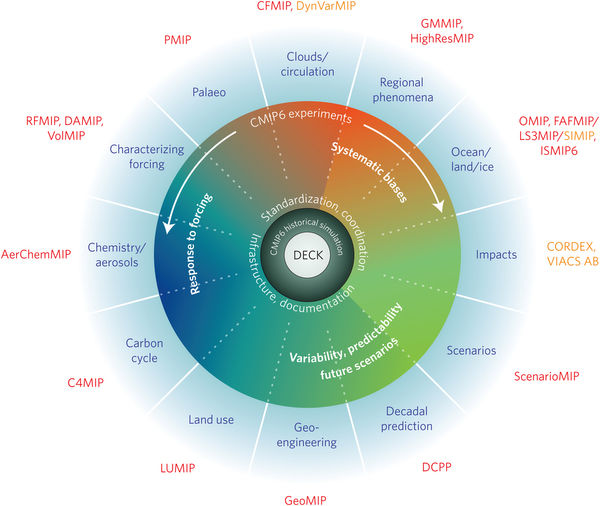
Adapted with permission from et al. Geosci. Model Dev. 9, 1937–1958 (2016).
- Walk us through ScenarioMIP.
-
ScenarioMIP is the main project providing multi-model projections based on alternative scenarios of emissions and socio-economic developments. Positioned at the science–policy interface, ScenarioMIP provides societally relevant information for climate-change mitigation, adaptation, and impacts, and was therefore developed in close collaboration with the IAM and impacts communities. The new scenarios sit in a matrix framework of Shared Socioeconomic Pathways (SSPs) and RCPs, allowing us to better address the impact of climate policy through enhanced socio-economic coupling. ScenarioMIP also fills critical gaps in our understanding of the effects of particular forcings, such as land use and short-lived species, the impacts of temperature overshoots, and 1.5 °C versus 2 °C scenarios.
- In terms of the models themselves, what’s new and improved this time round?
-
There have been quite a few developments with the models for CMIP6. Over the years, the number of participating modelling groups has tripled, and with CMIP6 more than 10 new groups will contribute for the first time, increasing the total registered to over 30. CMIP6 also sees increased model variety, allowing different versions with different resolutions to answer specific questions surrounding individual CMIP6-Endorsed-MIPs. HighResMIP, for example, will run at global resolutions of 25 km. Overall, it seems that ocean resolution will also be enhanced compared to CMIP5. Finally, the models now include new and more complex processes, including interactive chemistry, active land processes, ice sheets, and permafrost, to name a few.
- When will the data be available?
-
The historical forcing datasets became available at the end of 2016, allowing the modelling centres to start running their DECK and historical simulations. Forcing datasets for future projections will become available end of 2017. All things going to plan, the CMIP6-Endorsed MIPs will run over 2017–2019, meaning results will start to emerge in 2018–2020 in time to contribute to the IPCC’s Sixth Assessment Report.
- Is there any particular aspect of CMIP6 that you are most excited about?
-
I’m really excited to see the outcome of the CMIP6-Endorsed MIPs, which have worked extremely well. It is really amazing how collaborative the scientific community is, and, with the community-driven design, I expect we will make considerable progress on the three overarching scientific questions. This, I anticipate, will include significant advances in our process understanding, but I would also expect to see increased confidence in results due to the larger ensemble, as well as enhanced utilization of new methods such as emergent constraints. The CMIP6 model output will fuel climate research for the next 5 to 10 years, while its careful analysis will form the basis for future climate assessments.
We are also developing new CMIP evaluation tools to facilitate the assessment of the models: the Earth System Model Evaluation Tool (ESMValTool) and the PCMDI Metrics Package (PMP). The plan is to run these tools alongside the ESGF, streamlining analysis and providing standard diagnostics much faster than was possible for CMIP5. I’m excited to reduce the need for repetitive coding, which is becoming increasingly time-consuming as more models and data become available. This standardization of analysis codes will allow the reproducibility of performance metrics and diagnostics we need to assess the model ensemble while ensuring traceability and provenance.
- What’s the future for CMIP?
-
So far, I think CMIP6 has been a huge success. The new organization in terms of a centralised DECK and historical simulations in combination with the community-driven CMIP6-Endorsed MIPs has been great, and this should definitely continue. While the community engagement has been phenomenal, the growing demands for CMIP will require strong institutional support and substantial efforts for basic CMIP activities, such as the creation of forcing datasets, the provision and archiving of CMIP products, and model development. There also needs to be increased interaction between the observation and model communities. There are still many processes that we cannot constrain in the models, and the only way to do so will be to fill observational gaps. We also need to invest in and strengthen connections with the impact community. While CMIP6 has established the Vulnerability, Impacts, Adaptation and Climate Services Advisory Board, this is such a huge undertaking, with different needs for different sectors, that communities have to move together to make progress.
Interview by Graham Simpkins