


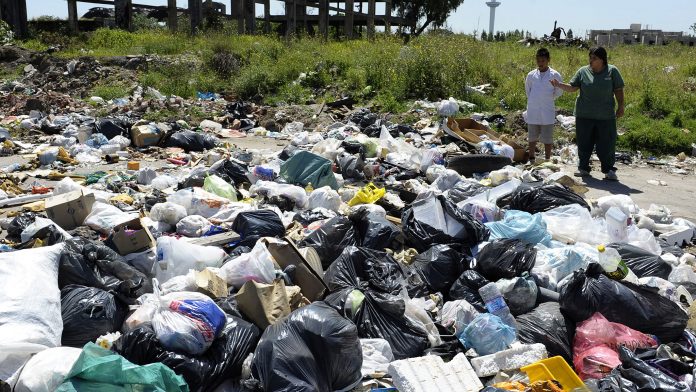
Dumped: supermarket plastic bags are now banned © Juan Mabromata/AFP/Getty Images
Across Buenos Aires, a green and yellow Ciudad Verde logo can be seen emblazoned on the ubiquitous rubbish trucks and the uniforms of street sweepers. The words translate as Green City and serve as a reminder of an official drive to make the capital cleaner and more environmentally friendly.
Eduardo Macchiavelli, the city’s minister of environment and public space, says he aims to make the city “more liveable”.
He works near the fashionable district of San Telmo, in a converted factory. It has the buzz and air of a tech company with plentiful provision of recycling bins for paper, plastic and even tea leaves. It is a way of life and work that Mr Macchiavelli would like to extend across the whole city.
At the start of the year, the government imposed a ban on plastic bags in supermarkets. Mr Macchiavelli feared protest. “But in very little time, people altered their habits,” he says. “Now plastic bags are something of the past.”
Other efforts have caught on. Large avenues in the city now have dedicated bus lanes, cutting air and noise pollution in their environs by 40 per cent, the minister says.
Waste collection has improved. Residents once would leave bagged rubbish on the pavement in front of their houses and collectors would throw the bags into a passing truck, often leaving litter in their wake. From last year, 28,000 large bins were distributed around the city and trucks empty them with mechanical arms, leaving less mess.
A recycling drive has reduced what needs collecting. “Five years ago, the city buried 100 per cent of its trash,” Mr Macchiavelli says. “Now less than half goes to the dump.”
More projects are planned or in process. Underground rainwater channels are undergoing expansion to reduce the threat of flooding. Street lighting is being replaced with energy efficient LED lamps and vehicle emission controls are being imposed.
There are plans to collect used cooking oil and electronic and hazardous waste, much of which at present winds up untreated in dumps. Solar power is being tested in parks and hybrid electric buses are to make their first journeys this year.
Public education is an important part of the drive. In 2010, the city launched Green Schools, a programme to raise awareness about recycling and to start vegetable gardens and other ecology-friendly schemes in schools.
“Students are possible agents of change,” says Damasia Ezcurra, who runs the education ministry’s sustainability programmes. “If a child teaches a parent how to recycle, it is much more effective than a politician telling them what to do.”
While the city is looking better, a lot more needs to be done to improve the environment, says Antonio Brailovsky, an author and specialist on the history of the city’s ecology. More could be done to insulate homes to reduce energy consumption, he offers as an example. “Sometimes the main problems are the ones you do not see,” he adds.
Five years ago, the city buried 100 per cent of its trash. Now less than half goes to the dump
One of Buenos Aires’ worst problems, he says, is the Riachuelo river on the city’s southern fringe that has been polluted for more than a century. It feeds into the River Plate, a source of the city’s drinking water.
In 2008, the supreme court ordered the river to be cleaned up, a task for Acumar, an independent public body that is working with the city, provincial and national governments.
Shanty dwellings have been removed from the banks of the Riachuelo and abandoned vehicles and boats hauled from its depths. “But the quality of the water is the same as before,” says Mr Brailovsky. He adds that the river bottom remains contaminated and untreated sewage and industrial waste continue to flow in.
In the neighbourhood of La Boca, bordering the Riachuelo, foul odours from the river can be detected on the streets. Some locals, however, say the smell has improved. One of them, Fabiana Valgiusti, is so enthused about the idea of a clean river that she is working with fellow residents to revive a rowing club that enjoyed its sport on the Riachuelo in the cleaner days of the mid-20th century.
There are hopes for more advances in cleaning the river. Rodolfo Tarraubella, a climate finance expert at Cifal Argentina, a UN network of training centres, says green bonds can be sold to help fund sanitation work. The World Bank has made $718m available, some of which has been spent on equipment such as tunnel-boring machines to help the effort. Argentina is spending $122m on a wastewater treatment plant as part of the scheme.
Alfredo Alberti, a long-time resident who runs a neighbourhood association in La Boca lobbying for a cleaner Riachuelo, says corruption and official inaction have stymied the community’s efforts. Time has been wasted on legalities, he adds, but he is resolved not to give up.
“The only fight you lose”, he says, “is the one you abandon”.