


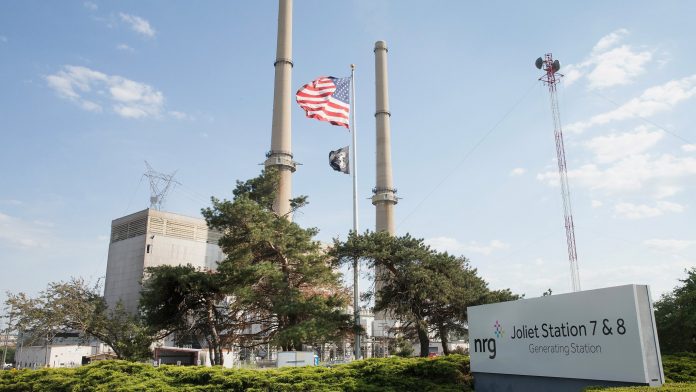
Two competing models of shareholder activism are clashing over the future of NRG Energy, the second-largest US electricity producer. Investors are being asked to choose between an activist fund’s performance-driven push to shake up the company, and a call from New York City’s chief financial official for it to retain its renewable energy investments and dismiss a director for his views on climate change.
In February, Elliott Management and Bluescape Energy Partners, another investment firm, agreed a deal with NRG under which two new directors joined its board and were given seats on a “business review committee” seeking ways to improve performance, including cost reductions and possible asset sales. Elliott controls 6.9 per cent of NRG and Bluescape has a further 2.5 per cent.
Most of NRG’s capacity is gas or coal-fired, but it has been investing in wind and solar power, and in 2014 it set a goal of halving its greenhouse gas emissions by 2030. Mauricio Gutierrez, chief executive, defended that strategy in a letter to shareholders last month, saying NRG was committed to “increasing our mix of newer, cleaner energy sources,” but analysts have suggested that the business review could lead to some or all of its renewable energy assets being sold.
However, Scott Stringer, the New York City comptroller who has responsibility for the city’s pension funds, has written an open letter to NRG’s shareholders, praising the company’s performance since Mr Gutierrez took over in December 2015, and questioning the need for further cost cuts and asset sales.
Mr Stringer, who controls about 0.4 per cent of NRG’s shares, argues that “Elliott/Bluescape’s short-term orientation . . . [is] on a collision course with NRG’s strategy to maximise long-term shareowner value”.
The letter also takes aim at Barry Smitherman, a former energy regulator in Texas who is one of the two newly appointed directors at NRG, over his opinions on climate change, citing a 2013 email in which he said he had been “battling this global warming hoax for 6 years now.”
Mr Stringer argues that Mr Smitherman’s views are incompatible with NRG’s strategy, and is calling for investors to vote him off the board at the company’s annual meeting on April 27.
Elliott rejects Mr Stringer’s framing of the debate over NRG as a dispute over climate change, and says it is agnostic between different energy sources, seeking only to maximise value. It says NRG chose Mr Smitherman for its board because of his deep knowledge of Texas, where the company has about a quarter of its generation capacity and is the largest competitive retail energy provider.
In the year before Mr Gutierrez became chief executive, NRG delivered a negative total shareholder return of 64 per cent, compared to a loss of 5.8 per cent for the S&P 500 utilities index, according to Mr Stringer. In the 13 months between Mr Gutierrez’s appointment and Elliott’s interest becoming public, however, NRG delivered a positive total shareholder return of 36 per cent, outpacing the 21.3 per cent for the utilities index.
Sample the FT’s top stories for a week
You select the topic, we deliver the news.