


Ema Peter
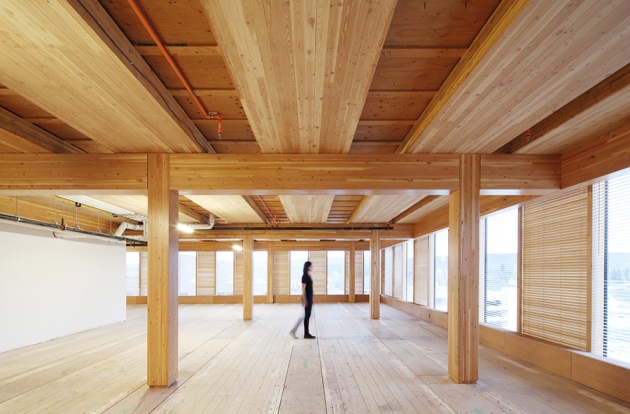
Canada’s Wood Innovation and Design Centre has an entirely wooden structure, showcasing the potential for high-rise wooden buildings that lock up carbon.
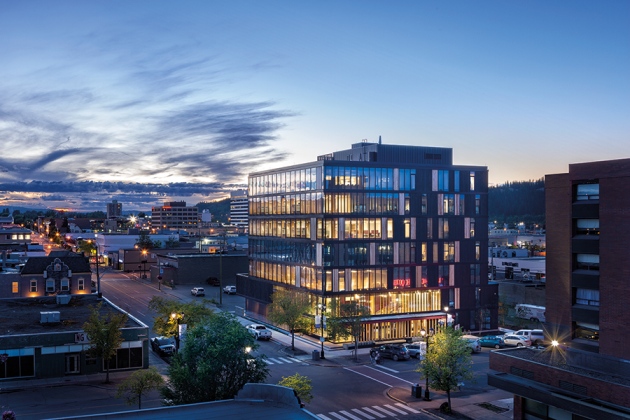
One building stands out in the old logging town of Prince George, Canada. Encased in a sleek glass facade, the structure towers above most of its neighbours, beckoning from afar with the warm amber glow of Douglas fir. Constructed almost entirely from timber in 2014, the 8-storey, 30-metre building is among the tallest modern wooden structures in the world. But it is more than an architectural marvel. As the home of the Wood Innovation and Design Centre at the University of Northern British Columbia (UNBC), it is also an incubator for wooden buildings of the future — and a herald for a movement that could help to tackle global warming.
The building is less like a log cabin and more like a layered cake, constructed from wooden planks glued and pressed together, precision cut by factory lasers and then assembled on site. All told, the university avoided the release of more than 400 tonnes of carbon dioxide by eschewing energy-intensive concrete and steel, and the building locks up a further 1,100 tonnes of CO2 that was harvested from the atmosphere by British Columbian trees. In total, that’s enough to offset the emissions from 160 households for a year.
Wooden construction has ancient roots, but only in the past two decades have scientists, engineers and architects begun to recognize its potential to stave off global warming. By substituting concrete and steel with wood from sustainably managed forests, the building industry could curb up to 31% of global carbon emissions, according to research1 by Chad Oliver, a forest ecologist at Yale University in New Haven, Connecticut. In time, such a shift could help humanity to pull CO2 out of the atmosphere, potentially reversing the course of climate change.
“It’s the plywood miracle,” says Christopher Schwalm, an ecologist at Woods Hole Research Center in Falmouth, Massachusetts. “This is something that could have a significant impact on the riddle that is global environmental change.”
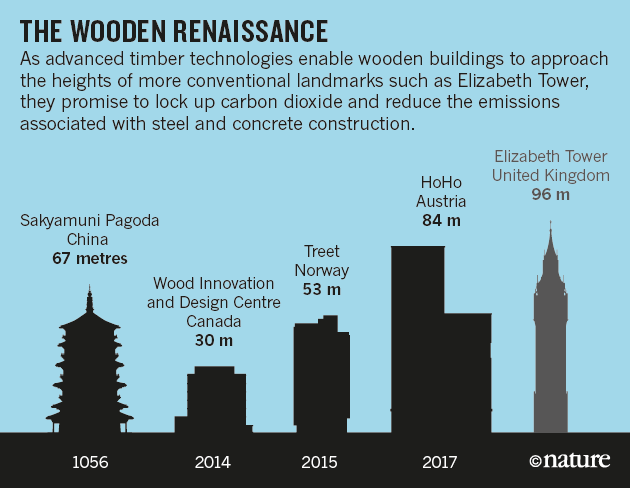
The renaissance in tall wooden buildings is already under way. Norway set a world height record in late 2015 with a 52.8-metre tower block; that was edged out in September 2016 by a 53-metre student dormitory at the University of British Columbia in Vancouver. This year, Austria will take the lead with the 84-metre HoHo building in Vienna, comprising a hotel, apartments and offices. The United States saw its first tall wooden building go up in Minneapolis, Minnesota, in 2016, and others are in the works in Portland, Oregon, and in New York City.
Wooden construction has attracted political interest in part because of the economic benefits for rural communities surrounded by forests. But turning these pioneering projects into a global trend won’t be easy. Building costs are often high, and the global construction industry is almost entirely focused on concrete and steel, particularly when it comes to big buildings. And the climate benefits of building with wood hinge on a questionable assumption: that the world’s forests will be managed sustainably. Some researchers worry that harvesting more timber could harm forest ecosystems, particularly in developing countries that are already plagued by poor and often illegal logging practices. “If we’re going to cut wood, we’ve got to do it in a way that not only sustains the forest but also sustains the biodiversity and everything else,” says Oliver.
Timber technology
Steel and concrete weren’t an option when Buddhist monks set about building a 32-metre pagoda at the Learning Temple of the Flourishing Law in Ikaruga, Japan, 14 centuries ago. They put their faith in wood, as did the monks at the Sakyamuni Pagoda in Yingxian, China. Erected in 1056, that structure rises a staggering 67 metres towards the heavens.
These pagodas are still standing today, a testament to the strength and durability of wood. Kilogram for kilogram, wood is stronger than both steel and concrete, and wooden buildings are generally good at withstanding earthquakes. But wood has developed a bad reputation over the centuries, because of catastrophic blazes that levelled cities such as London, New York and Chicago before modern fire-suppression strategies emerged. In fact, in case of fire wood maintains its structurally integrity much better than the non-flammable alternatives favoured by modern building codes. It chars at a predictable rate, and doesn’t melt like steel or weaken like concrete. “The fact that it actually can withstand fire better than steel took a long time for people to realize,” says Guido Wimmers, who chairs a master’s programme in wood engineering at UNBC.
By some accounts, the modern era of tall wooden buildings began 20 years ago, with a simple experiment at the Technical University of Graz in Austria. Researchers glued layers of standard planks perpendicular to each other, and discovered that alternating the direction of the grain effectively negated the imperfections and weaknesses in any given plank. The result, known as cross-laminated timber, is a strong and lightweight wood panel that puts conventional plywood to shame. It can be made as large as desired and cut with sub-millimetre precision at the factory, which speeds up construction and reduces waste. And given the strength of these panels, there’s no theoretical limit to how high wooden buildings can grow. “It transforms wood from a suburban material to a very urban material,” says Michael Green, the Vancouver-based architect behind UNBC’s design centre, and a leading advocate for wooden construction.
Wimmers says the initial goal of the technology was to make better use of low-grade wood products. “The wood construction industry was slowly vanishing, so they started to reinvent themselves,” he says. Then the market for advanced timber technologies — including beams that are either glued or nailed together to increase strength — expanded as European countries put strict regulations on energy efficiency and greenhouse-gas emissions, forcing architects to reduce the climate footprints of their buildings. Wimmers estimates that in Europe, wood is now used in about 25% of residential construction, up from 5–10% in the 1990s.
Ed White
The exterior of the Wood Innovation and Design Centre was inspired by bark peeling from a tree trunk.
The science of safety and engineering has also advanced. Douglas fir — the exposed layer at the UNBC centre — chars at 39 millimetres per hour. The provincial building code requires that the structure be able to endure at least one hour of fire on any given storey, so Green’s team opted for floors made of a 5-layer panel that could afford to sacrifice a portion without losing its structural integrity.
Meanwhile, Wimmers’s team is collaborating on the Tall Wood Project, funded by the US National Science Foundation, to improve earthquake resistance for high wooden buildings. Work by the consortium has shown that the buildings can withstand earthquakes as well as or better than concrete and steel2, and the researchers will begin testing a two-storey wooden structure on a quake-simulator table at the University of California, San Diego, in June. They aim to test a ten-storey building there by 2020.
Asif Iqbal, a civil engineer who is working on the project, came to UNBC from New Zealand, where he saw the damage from the 2011 earthquake in Christchurch at first hand. Most of the steel-reinforced concrete buildings in the city remained standing, but around 1,800 were irreparably damaged owing to cracked concrete and warped steel. Iqbal says that many of the replacement buildings are being constructed from wood, precisely because it is more likely to survive another major earthquake and the steel connectors can be replaced relatively easily if damaged.
The long-term performance and economic viability of these buildings remains an open question. Wood is susceptible to mould and water damage, for example, and there is a higher risk of fire during construction. In September 2014, a £20-million (US$26-million) wooden sustainable-chemistry building being built at the University of Nottingham, UK, was destroyed by an electrical fire — in part because fire doors and windows were not yet in place to contain the blaze. Still, advocates say the future looks bright. “We are still fine-tuning wood technologies, but so far we haven’t found any major issues that we cannot solve,” Iqbal says.
Tracking carbon
One of the main attractions of wooden construction is its potential to help stave off global warming. Oliver’s research1 suggests that humans currently harvest only 20% or so of the global forest growth each year, and more timber could be extracted without reducing the overall amount of carbon locked up in forests. The eventual climate impact of this harvest depends on the end use.
If the wood were simply burned for energy, the CO2 that the tree had absorbed years earlier would immediately return to the atmosphere. Regrowing forests eventually pull that CO2 back out of the air, so the idea of carbon-neutral wood energy is a function of time. It is also controversial: some argue that current policies in Europe overstate the climate benefits of wood fuel and create perverse incentives to cut down trees. But this debate doesn’t apply to wooden buildings. “Just the fact that you have solid wood means that you are keeping CO2 out of the atmosphere,” says Oliver.
Image Slideshow
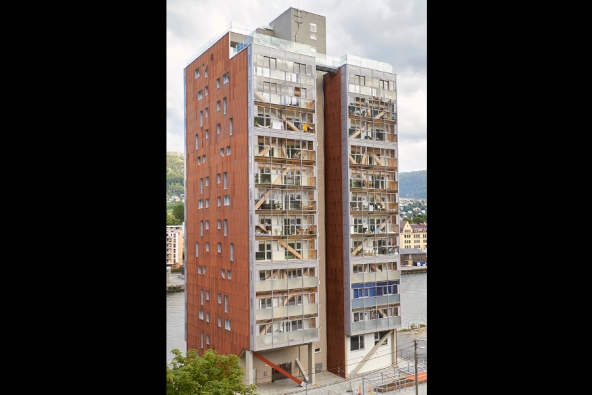
In 2015, Treet (‘The Tree’) in Bergen, Norway, briefly became the world’s tallest modern wooden building, at 52.8 metres. Comprising 14 storeys and containing 62 flats, it was constructed using modular, prefabricated sections.
Thomas F/Alamy

Last year, a 53-metre dormitory at the University of British Columbia in Vancouver took wooden construction to new heights. Once its prefabricated elements were delivered to the site, it took less than 70 days to complete the building work. More than 400 students will move into their new home in September.
KK Law/naturallywood.com
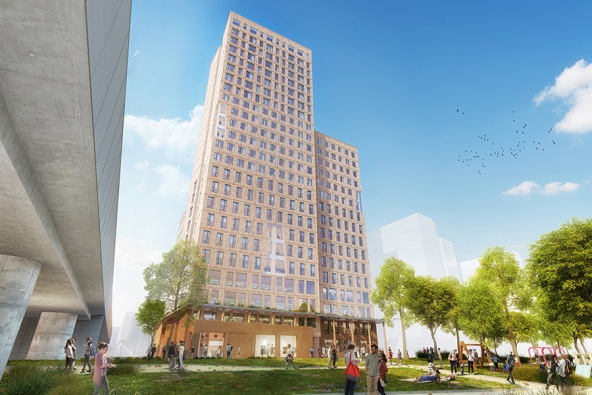
Construction crews in Vienna are now creating HoHo, an 84-metre skyscraper that will take the all-time height record for a wooden building. Although it includes supporting concrete cores, about three-quarters of the structure is made of spruce.
A3ZO
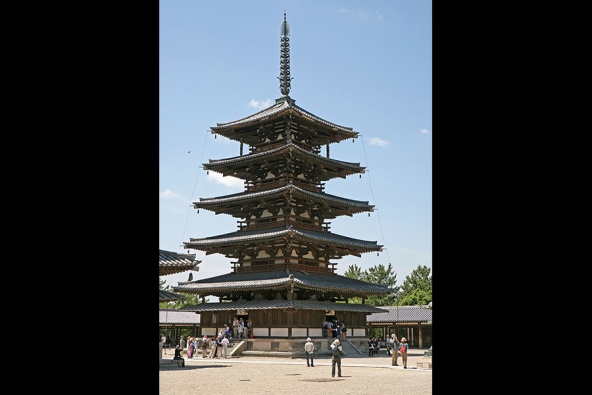
At the Learning Temple of the Flourishing Law in Ikaruga, Japan, a 5-storey wooden pagoda reaches 32 metres into the sky. The pagoda dates from the late seventh or early eighth century, although it has been repaired and reconstructed since then.
Nigel Reed/QEDimages/Alamy

The Sakyamuni Pagoda in Yingxian was constructed in 1056, during the Liao Dynasty. At a towering 67 metres, it is the tallest ancient wooden building in the world, and has withstood many earthquakes during its life.
DeAgostini/Getty