


January 24th, 2019
Any decision obliging the State to ramp up emissions targets under a revised climate plan would have a fundamental impact on Irish society, the High Court heard today during the landmark climate case.
During her opening statement this morning, Niamh Hyland SC told Mr Justice Michael MacGrath that emissions targets sought by the applicant Friends of the Irish Environment (FiE) under a revised National Mitigation Plan would have “enormous implications” for our society.
The Plan includes over 100 actions that the Government intends to put in place in order to advance its goal of at least 80 per cent reduction in emissions by 2050 compared to 1990 levels.
Yesterday, however, Eoin McCullough SC said that the design of the Plan is “not calculated to achieve substantial emissions reductions in the short term or indeed in the medium term” and that emissions are in fact rising.
In this light, FiE wants the court to quash the Plan and send it back to the Government to be redesigned to achieve substantial emission reductions in the short and medium-term.
Ms Hyland argued that the 2020 emissions targets that the applicant wants to see in a revised Plan of between 25 and 40 per cent below 1990 levels will have wide-ranging impacts on Irish society.
The “extreme alterations” to our way of life required to reach this target, Ms Hyland said, would include the need to cull the entire cattle herd.
Agriculture accounts for 44 per cent of total emissions in the non-ETS section that also includes transport, residential, commercial, non-energy intensive industry and waste.
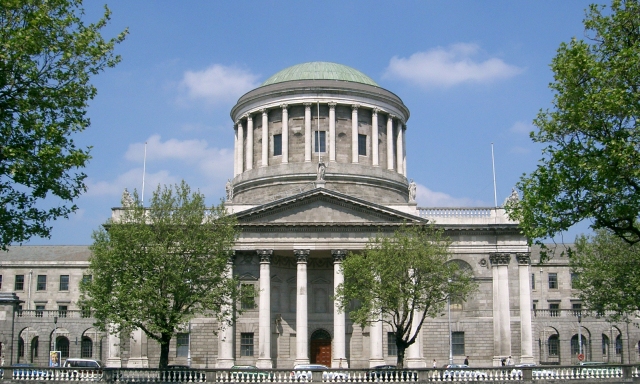
The Four Courts Building Photo: Gary Barber
It’s science or the Law
Ms Hyland said that “one of the striking things” in the case is that the applicant’s arguments are centred on science, while the State’s is one based on law.
The case, she said, is not really about the Plan at all and that it “is just a vehicle” for the applicant to seek a statement from the courts that the State’s approach to limit emissions is unconstitutional.
She said that FiE is essentially seeking a judgement that would see the judiciary “put straight into the position of the executive… telling the state what [emissions] reduction is to be achieved by a particular date”.
Such a judgement, Ms Hyland said, would “create a parallel track of obligations” on a national level alongside both EU and international obligations that Ireland must also achieve.
Ms Hyland said that national emissions targets outlined in EU and international decisions are a result of negotiations by the States concerned in their executive function.
The notion, she said, that someone unhappy with determined targets could come before the courts and seek a judgement for higher targets is not acceptable as “those choices are quintessentially for the executive to decide”.

FiE and Climate Case supporters outside High Court Photo: Niall Sargent
‘False premise’ in State argument
On Tuesday, Mr McCullough said this line of argument is a “false premise that lies right through the State’s submissions”.
“[The State] says that the applicant is trying to impose what it calls a positive obligation to deliver a particular prescribed plan,” he said.
In fact, Mr McCullough said, the applicant does not seek to prescribe the types of emissions reductions that must be made not does it seek a declaration that the State must bring about a certain level of emission reductions.
“[The applicant] doesn’t pretend to put forward what the State describes as it’s prescribed policy, rather it simply says… the plan is not calculated to achieve substantial reductions is in breach of the Constitution and of the European Convention on Human Rights,” Mr McCullough said.
“The substantial premise of the State’s case and Defence falls away when one understands those points,” he added.
The case continues this afternoon.
About the Author

The post Higher climate targets would have ‘fundamental societal impact’ appeared first on Green News Ireland.