


Begin Slideshow 62
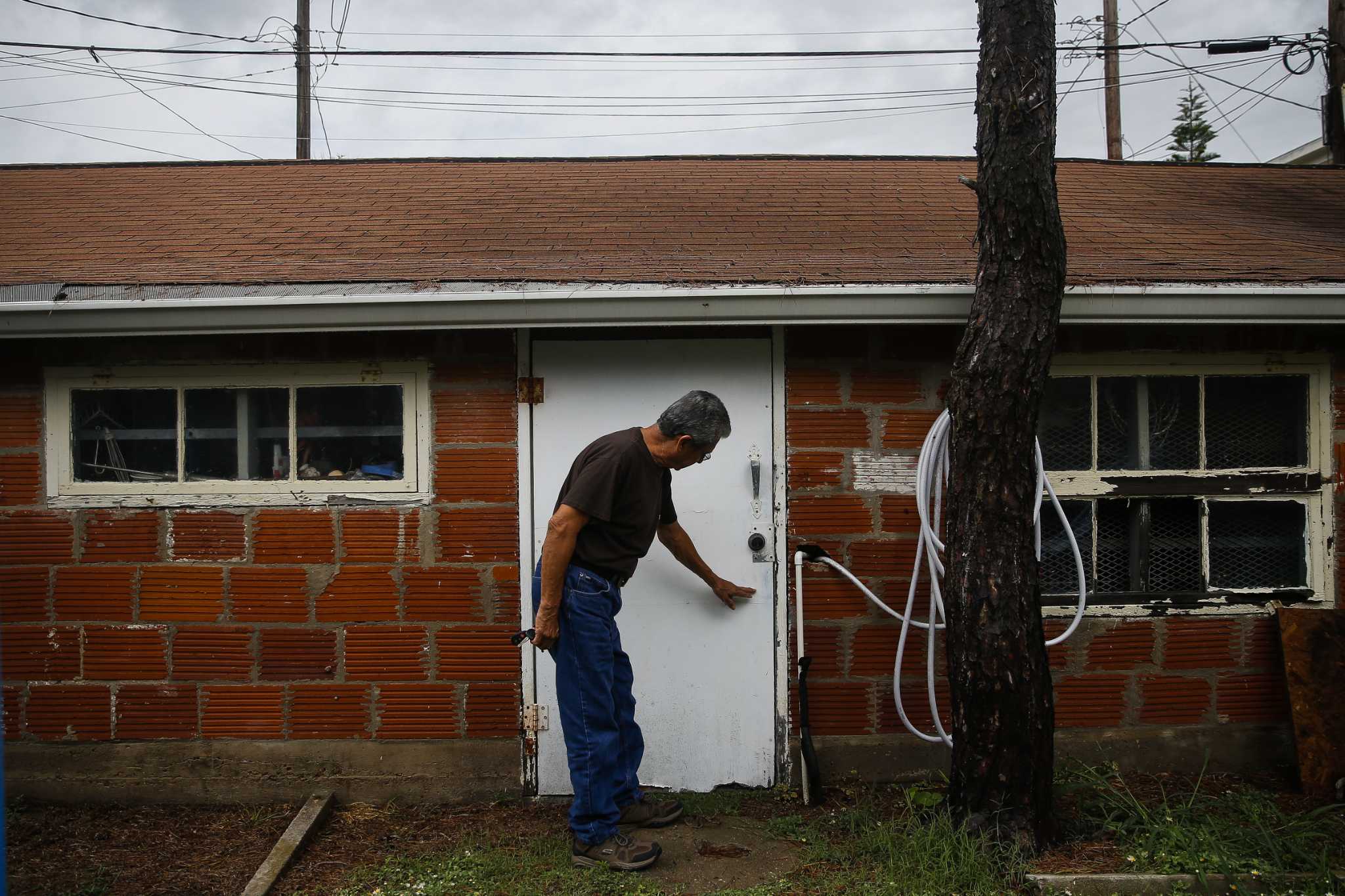
Lalo Ojeda points to the water line on his garage in Galveston from Hurricane Ike in 2008.
Lalo Ojeda points to the water line on his garage in Galveston from Hurricane Ike in 2008.
Photo: Michael Ciaglo, Staff
Eulalio Ojeda holds a photo he took of the seawall after Hurricane Ike Monday, May 22, 2017 in Galveston.
Eulalio Ojeda holds a photo he took of the seawall after Hurricane Ike Monday, May 22, 2017 in Galveston.
Photo: Michael Ciaglo, Houston Chronicle
Eulalio Ojeda points at the water line on his garage from Hurricane Ike Monday, May 22, 2017 in Galveston.
Eulalio Ojeda points at the water line on his garage from Hurricane Ike Monday, May 22, 2017 in Galveston.
Photo: Michael Ciaglo, Houston Chronicle
Eulalio Ojeda uncovers a generator at the back of his house that he bought for hurricane season Monday, May 22, 2017 in Galveston.
Eulalio Ojeda uncovers a generator at the back of his house that he bought for hurricane season Monday, May 22, 2017 in Galveston.
Photo: Michael Ciaglo, Houston Chronicle
GRAPHICS: Paths of landfalls of Texas’ worst hurricanes
See the storm paths and landfall points of Texas’ biggest hurricanes and tropical storms …
GRAPHICS: Paths of landfalls of Texas’ worst hurricanes
See the storm paths and landfall points of Texas’ biggest hurricanes and tropical storms …
Photo: NOAA Data | ESRI Imaging
1900 Unnamed (Great Galveston Hurricane)
Formed August 1900
1900 Unnamed (Great Galveston Hurricane)
Formed August 1900
Photo: NOAA Data | ESRI Imaging
Hurricane Alice
Formed December 1954
Hurricane Alice
Formed December 1954
Photo: NOAA Data | ESRI Imaging
Hurricane Audrey
Formed June 1957
Hurricane Audrey
Formed June 1957
Photo: NOAA Data | ESRI Imaging
Hurricane Debra
Formed July 1959
Hurricane Debra
Formed July 1959
Photo: NOAA Data | ESRI Imaging
Hurricane Carla
Formed September 1961
Hurricane Carla
Formed September 1961
Photo: NOAA Data | ESRI Imaging
Hurricane Cindy
Formed September 1963
Hurricane Cindy
Formed September 1963
Photo: NOAA Data | ESRI Imaging
Hurricane Beulah
Formed September 1967
Hurricane Beulah
Formed September 1967
Photo: NOAA Data | ESRI Imaging
Hurricane Celia
Formed July 1970
Hurricane Celia
Formed July 1970
Photo: NOAA Data | ESRI Imaging
Hurricane Fern
Formed September 1971
Hurricane Fern
Formed September 1971
Photo: NOAA Data | ESRI Imaging
Hurricane Allen
Formed August 1980
Hurricane Allen
Formed August 1980
Photo: NOAA Data | ESRI Imaging
Tropical Storm Danielle
Formed September 1980
Tropical Storm Danielle
Formed September 1980
Photo: NOAA Data | ESRI Imaging
Hurricane Alicia
Formed August 1983
Hurricane Alicia
Formed August 1983
Photo: NOAA Data | ESRI Imaging
Hurricane Bonnie
Formed June 1986
Hurricane Bonnie
Formed June 1986
Photo: NOAA Data | ESRI Imaging
Hurricane Gilbert
Formed September 1988
Hurricane Gilbert
Formed September 1988
Photo: NOAA Data | ESRI Imaging
Hurricane Chantal
Formed August 1989
Hurricane Chantal
Formed August 1989
Photo: NOAA Data | ESRI Imaging
Hurricane Jerry
Formed October 1989
Hurricane Jerry
Formed October 1989
Photo: NOAA Data | ESRI Imaging
Tropical Storm Allison
Formed June 1989
Tropical Storm Allison
Formed June 1989
Photo: NOAA Data | ESRI Imaging
Hurricane Lidia
Formed September 1993
Hurricane Lidia
Formed September 1993
Photo: NOAA Data | ESRI Imaging
Tropical Storm Arlene
Formed June 1993
Tropical Storm Arlene
Formed June 1993
Photo: NOAA Data | ESRI Imaging
Tropical Storm Dean
Formed July 1995
Tropical Storm Dean
Formed July 1995
Photo: NOAA Data | ESRI Imaging
Tropical Storm Charley
Formed August 1998
Tropical Storm Charley
Formed August 1998
Photo: NOAA Data | ESRI Imaging
Tropical Storm Frances
Formed September 1998
Tropical Storm Frances
Formed September 1998
Photo: NOAA Data | ESRI Imaging
Hurricane Bret
Formed August 1999
Hurricane Bret
Formed August 1999
Photo: NOAA Data | ESRI Imaging
Tropical Storm Allison
Formed June 2001
Tropical Storm Allison
Formed June 2001
Photo: NOAA Data | ESRI Imaging
Tropical Storm Bertha
Formed August 2002
Tropical Storm Bertha
Formed August 2002
Photo: NOAA Data | ESRI Imaging
Tropical Storm Fay
Formed September 2002
Tropical Storm Fay
Formed September 2002
Photo: NOAA Data | ESRI Imaging
Hurricane Claudette
Formed July 2003
Hurricane Claudette
Formed July 2003
Photo: NOAA Data | ESRI Imaging
Tropical Storm Grace
Formed August 2003
Tropical Storm Grace
Formed August 2003
Photo: NOAA Data | ESRI Imaging
Hurricane Ivan
Formed September 2004
Hurricane Ivan
Formed September 2004
Photo: NOAA Data , ESRI Imaging
Hurricane Rita
Formed September 2005
Hurricane Rita
Formed September 2005
Photo: NOAA Data | ESRI Imaging
Hurricane Humberto
Formed September 2007
Hurricane Humberto
Formed September 2007
Photo: NOAA Data | ESRI Imaging
Tropical Storm Erin
Formed August 2007
Tropical Storm Erin
Formed August 2007
Photo: NOAA Data | ESRI Imaging
Hurricane Dolly
Formed July 2008
Hurricane Dolly
Formed July 2008
Photo: NOAA Data | ESRI Imaging
Hurricane Gustav
Formed September 2008
Hurricane Gustav
Formed September 2008
Photo: NOAA Data | ESRI Imaging
Hurricane Ike
Formed September 2008
Hurricane Ike
Formed September 2008
Photo: NOAA Data | ESRI Imaging
Tropical Storm Edouard
Formed August 2008
Tropical Storm Edouard
Formed August 2008
Photo: NOAA Data | ESRI Imaging
Tropical Storm Hermine
Formed September 2010
Tropical Storm Hermine
Formed September 2010
Photo: NOAA Data | ESRI Imaging
Tropical Storm Don
Formed July 2011
Tropical Storm Don
Formed July 2011
Photo: NOAA Data | ESRI Imaging
The highest elevation in Galveston at the time was only 8.7 feet above sea level. This storm brought with it a storm surge of more than 15 feet. Evacuation efforts were hampered when rising water washed away train tracks. Twenty percent of the island’s population was killed, or an estimated 8,000 people.
The highest elevation in Galveston at the time was only 8.7 feet above sea level. This storm brought with it a storm surge of more than 15 feet. Evacuation efforts were hampered when
Photo: U.S. Library Of Congress
The Gresham house, center, now known as the Bishop’s Palace, sits relatively unscathed behind a wall of debris following the hurricane that devastated Galveston.
The Gresham house, center, now known as the Bishop’s Palace, sits relatively unscathed behind a wall of debris following the hurricane that devastated Galveston.
Photo: AP
African American men carrying body on stretcher, surrounded by wreckage of the hurricane and flood, Galveston, Texas. (
African American men carrying body on stretcher, surrounded by wreckage of the hurricane and flood, Galveston, Texas. (
Photo: Buyenlarge, Getty Images
The Hurricane of 1900 made landfall on the city of Galveston, Texas on September 8, 1900. It had estimated winds of 135 mph (215 km/h) at landfall, making it a Category 4 storm.
The Hurricane of 1900 made landfall on the city of Galveston, Texas on September 8, 1900. It had estimated winds of 135 mph (215 km/h) at landfall, making it a Category 4 storm.
Photo: Buyenlarge, Getty Images
After the 1900 storm, Galveston built a 15-foot-tall seawall. This storm, 15 years later, brought a storm surge of 16 feet. Downtown Galveston found itself in waist-deep water, but the seawall did its job: only 11 people in the city were killed. It took months to remove ships stranded by high water.
After the 1900 storm, Galveston built a 15-foot-tall seawall. This storm, 15 years later, brought a storm surge of 16 feet. Downtown Galveston found itself in waist-deep water, but the
Photo: AP
Before the storm made landfall near the Texas-Louisiana line, a storm surge 12 feet in some places disrupted oil production in the Gulf. Damage to offshore rigs was estimated at $16 million. The storm weakened as it moved inland, but it combined with a low near Chicago and re-intensified. Gusts of 100 mph wind were reported in Jamestown, New York.
Before the storm made landfall near the Texas-Louisiana line, a storm surge 12 feet in some places disrupted oil production in the Gulf. Damage to offshore rigs was estimated at $16
A young Dan Rather reported from the Galveston seawall–the first live TV broadcast of a hurricane. Gusts as high as 170 mph were observed in Port Lavaca. The storm spawned a tornado that destroyed 60 buildings and killed 8 people in Galveston. A total of 43 people lost their lives in Hurricane Carla.
A young Dan Rather reported from the Galveston seawall–the first live TV broadcast of a hurricane. Gusts as high as 170 mph were observed in Port Lavaca. The storm spawned a tornado that
Photo: Sam C. Pierson Jr., Houston Chronicle
September 10, 1961 – Forty-six people were killed when Hurricane Carla makes landfall. Potentially more deaths were averted by one of the largest evacuations in history.
September 10, 1961 – Forty-six people were killed when Hurricane Carla makes landfall. Potentially more deaths were averted by one of the largest evacuations in history.
Photo: Grey Villet, Time & Life Pictures/Getty Image
Gusts up to 180 mph were measured in Aransas Pass. Port Aransas Beach was covered by more than nine feet of storm surge. Ninety percent of the buildings in downtown Corpus Christi suffered at least some damage. At least 8,000 homes were destroyed. Fifteen people died.
Gusts up to 180 mph were measured in Aransas Pass. Port Aransas Beach was covered by more than nine feet of storm surge. Ninety percent of the buildings in downtown Corpus Christi suffered
Photo: Coast And Geodetic Survey
The fifth major hurricane of the 2005 season put a scare into the Houston area, which had taken in refugees from Hurricane Katrina, a month before. An estimated 3.7 million Texans headed inland–some as far west as Odessa. As many as 107 died in the evacuation itself.
The fifth major hurricane of the 2005 season put a scare into the Houston area, which had taken in refugees from Hurricane Katrina, a month before. An estimated 3.7 million Texans headed
Photo: JASON REED, Reuters
Shrimping ships on Fisherman’s Warf in Sabine Pass remain smashed into one another on Saturday, October 8, 2005. (AP Photo/The Beaumont Enterprise, Mark M. Hancock)
Shrimping ships on Fisherman’s Warf in Sabine Pass remain smashed into one another on Saturday, October 8, 2005. (AP Photo/The Beaumont Enterprise, Mark M. Hancock)
Photo: Mark M. Hancock, Staff Photographer
Ike may not have been the strongest hurricane to strike the Texas coast, but it was one of the widest: the storm stretched from the Louisiana state line to Corpus Christi. The storm surge topped Galveston’s seawall. Windows were knocked out of the JPMorgan Chase Tower and Reliant Stadium was damaged.
Ike may not have been the strongest hurricane to strike the Texas coast, but it was one of the widest: the storm stretched from the Louisiana state line to Corpus Christi. The storm surge
Photo: David J. Phillip, POOL
Hurricane Andrew, 1992
When it struck, Andrew was the costliest storm in US history. Winds up to 177 mph brought catastrophic damage to Florida, where 63,000 homes were destroyed 100,000 more were damaged. Off-shore oil drillers reported a half billion dollars in losses resulting from the storm. Florida reported $25 billion in damages and 44 deaths.
Hurricane Andrew, 1992
When it struck, Andrew was the costliest storm in US history. Winds up to 177 mph brought catastrophic damage to Florida, where 63,000 homes were destroyed 100,000 more were damaged.
Photo: .
The storm was part of the record-breaking 2005 season that saw a handful of historic storms and historic damage, most notably that wrought by Katrina. It caused heavy damage in Cuba and the Caribbean before hitting Florida, where it caused 26 deaths. Up to 6,000,000 Floridians lost power for more than a week after the storm.
The storm was part of the record-breaking 2005 season that saw a handful of historic storms and historic damage, most notably that wrought by Katrina. It caused heavy damage in Cuba and the
Photo: JULIE JACOBSON
Hurricane Charley, 2004
Photo: .
The storm made landfall in South Carolina, killing 27 and leaving thousands homeless. At the time it was the most damaging hurricane on record.
The storm made landfall in South Carolina, killing 27 and leaving thousands homeless. At the time it was the most damaging hurricane on record.
Photo: .
Frances hit Florida on Labor Day weekend, just weeks after Hurricane Charley brought heavy damage to the state. Up to 50 deaths were attributed to the storm.
Frances hit Florida on Labor Day weekend, just weeks after Hurricane Charley brought heavy damage to the state. Up to 50 deaths were attributed to the storm.
Photo: DOUGLAS R. CLIFFORD, AP
GALVESTON – Lalo Ojeda has lived with hurricanes all his life.
He was 14 when Hurricane Carla inundated Galveston Island in 1961. He evacuated as Hurricane Rita barreled toward the coast in 2005, then rode out the devastating Hurricane Ike in his Galveston home in 2008.
But Ojeda is watching the hurricane season that begins Thursday with more concern than usual. The retired Coast Guard employee worries that rising sea levels could make the next hurricane more destructive than those he’s lived through.
“That’s really scary to me,” the 70-year-old said.
A study released this month shows that rising sea levels threaten to make storm surges more dangerous, seemingly reinforcing Texas officials’ push for federal funding for a storm-surge barrier, or Ike Dike, to protect Galveston.
“Every storm surge today reaches higher because it starts from a higher level, because sea level is higher,” said study co-author Ben Strauss, a scientist who is vice president for sea level and climate impacts for Climate Central, a group of scientists and journalists dedicated to climate change awareness. “A small amount of sea-level rise can lead to an unexpectedly large increase in damages to most kinds of structures.”
Brian Streck, 62, a retired Galveston firefighter, has watched high tides creep into the streets around the house at the edge of West Galveston Bay, where he has lived for 37 years.
He has no patience for climate-change deniers who doubt seas are rising.
“I’ve witnessed it,” Streck said.
High tides once flooded the streets around his home about twice a year; the flooding in the last decade has increased to a dozen times a year.
“I’ve considered selling this place because eventually I’m going to have a lake house,” he said.
Rise accelerating
Scientific studies have established an acceleration in sea-level rise because of a warming atmosphere. Coal and oil burning and the destruction of tropical forests have increased heat-trapping gases that have warmed the planet by 1.8 degrees since 1880. Earth has been losing 13,500 square miles of ice annually since 1979, according to the National Oceanic and Atmospheric Administration.
Sea levels are generally rising faster along the Texas Gulf Coast and the western Gulf than the average globally, according to a January study by NOAA.
“The western Gulf is experiencing some of the highest rates of relative levels of sea-level rise in the country,” said NOAA oceanographer William Sweet, lead author of the study. “The ocean is not rising like water would in a bathtub.”
Sea-level rise is making storm surges larger, said John Nielsen-Gammon, Texas state climatologist at Texas A&M University in College Station.
“Compared to a storm that would have hit, say, 30 years ago, the additional storm surge we are talking about is on the order of … about 7 inches,” Nielsen-Gammon said.
Translator
To read this article in one of Houston’s most-spoken languages, click on the button below.
The NOAA study found sea levels rising at more than double the rate estimated during the 20th century, increasing to more than 0.13 inch annually. NOAA made six projections of sea-level rise, from low to extreme, and found the global mean level under the lowest projection could rise 2.3 inches by 2020 and 3.5 inches by 2030. The extreme projection shows a 4.3-inch rise by 2020 and a 9.4-inch rise by 2030.
Severe flooding likely
The rate of sea-level rise even under the lowest projection would increase the chances of severe flooding on the Texas Gulf Coast from storm surges or other causes from once every five years to once every two years by 2030 under the extreme projection, and 2060 under the low prediction.
“We’re not talking much longer than a mortgage cycle,” Sweet said. “I just bought a house, I’ve got a 30-year note. That’s 2047.”
By 2100, sea level is expected to rise between 1.3 feet and 31 feet, the NOAA study predicts; Galveston Island and most of the Texas coast would be swallowed up under the latter scenario.
Sweet said the lower levels were more likely, but added, “We ultimately don’t know how much heating will occur.”
He warned there was no guarantee rising sea level wouldn’t match the extreme prediction.
The effects will be felt as far away as Austin, according to a recently released study by Mathew E. Hauer, who heads the Institute of Government’s applied demography program at the University of Georgia. Hauer’s study found that sea-level rise would force thousands from their homes along the Texas Gulf Coast as well as coastal areas nationwide.
The study estimates Houston and Austin each would absorb 250,000 refugees from sea-level rise by 2100.
The hardest hit would be Galveston County, where Hauer estimates 124,000 people could be forced from their homes. Rising water would force about 108,000 from their homes in Jefferson County, 42,000 in Brazoria County and 30,000 in Harris County, Hauer said.
The Climate Central study estimated 14,000 homes in Galveston could be inundated by sea-level rise.
More intense storms
Apart from sea-level rise, climate change is expected to cause hurricanes to be more intense and produce more rain, according to the NOAA.
“In our view, there are better-than-even odds that the numbers of very intense hurricanes (Categories 4 and 5, with winds of 130 mph or more) will increase by a substantial fraction,” according to an overview of research by NOAA scientists.
The number of hurricanes each season would likely remain the same or decrease, the overview determined.
Funding for efforts to slow or halt sea-level rise generated by climate change was slashed in a recently released President Donald Trump administration budget.
Trump has called climate change a hoax, but a White House official said Friday that his views were evolving after recent talks with European leaders. His budget cuts Environmental Protection Agency funding by 30 percent, more than any other agency.
Texas officials have asked Trump to put a proposed $15 billion storm-surge barrier on his list of infrastructure improvements, but there is no guarantee Congress will fund the project.
Even if Congress pays for the barrier system – which would shield Brazoria, Galveston, Harris, Chambers, Jefferson and Orange counties – work couldn’t begin until 2021 at the earliest.
NOAA is predicting 11 to 17 named storms this season, which runs from Thursday to Nov. 30, five to nine of them hurricanes and two to four Category 3 or higher hurricanes.
According to emergency officials in Galveston and Brazoria counties, little can be done to offset the increasingly larger storm surges and reduce the likelihood of more destructive hurricanes.
One is unlucky number
Forecasts of hurricane frequency don’t matter, said Garret Foskit, Galveston County’s emergency management coordinator. What matters is if one hits your community, Foskit said.
“One is the unlucky number,” he said.
No matter the predictions, people who live in a hurricane’s path “are still going to have to do the same things,” Foskit said. “They are still going to have to leave, they are still going to have to move their stuff.”
Ojeda said he learned the hard way during Ike that it’s important to prepare.
“I’m a true believer that you learn by your mistakes,” he said. “I told the wife to buy more canned goods, dry stuff.”
He owns two emergency generators after going for nearly two weeks without electricity after Ike.
If a major hurricane approaches, he plans to evacuate.
Said Ojeda: “If a 200 mph hurricane hits this island, there is not going to be (anything) left.”