


August 21, 2019
In an oddly-phrased opinion piece in The Irish Times last Friday,
business journalist Mark Paul criticised those who argue that economic
contraction – degrowth – will bring about a happier society. He described them
as “fetishists” whose proposals would in fact cause severe suffering.
The author believes that green growth –
expanding the economy while avoiding environmental damage – is “a fallacy, the
biggest attempt to have cake and eat it in history”. But he suggests
that green growth may not be necessary anyway, as environmental degradation may
actually turn out to be a less serious problem than feared. Catastrophic
climate change, as the article puts it, is “only a risk, not a certainty”.
At the same time, the article finds that
there is absolute, rock-hard evidence that degrowth will always make people
“poorer, sadder and less healthy.” This, the author states, “is incontrovertible
fact”.
Accordingly, Paul seems annoyed by
“on-message” politicians and “woke” young people who claim that degrowth could
be a positive thing: “If you are going to champion degrowth, shouldn’t you look
people in the eye and tell them what it really means?”
He is most likely correct to have
concerns about degrowth’s potential negative effects. As with climate
disruption, it’s clear that economic contraction (or degrowth, or recession, if
you prefer) can present significant threats to the current economic system.
However, to borrow a phrase, these
threats are risks, not certainties. Yes, recessions have not been happy times,
historically. But Paul is wrong to assume that an economic contraction will
inevitably be highly socially damaging, with no chance whatsoever of any silver
lining in its effects on our wellbeing.
And his error is quite a troubling one, as it could contribute to misunderstandings and even panic, thus helping to bring about the very suffering that he’s worried about. Combine it with his downplaying of the risks presented by climate disruption and his stance becomes downright dangerous.
Mitigating the risks associated with
recessions
There is considerable research currently
underway that investigates the exact relationship between growth and wellbeing,
identifying steps that could help lessen the challenge and stress of dealing
with recessions.
While the data cited in The Irish
Times piece on the effects of recession is certainly a matter of concern,
other research paints a more nuanced picture. For example, Feasta’s ‘Measuring
Wellbeing’, in collaboration with the German research institute FEST, published a study in 2017 that used 20 different measures
to formulate a well-being index for Ireland.
Consumption, housework, voluntary work
and healthcare and education expenditure are among the positive factors
considered in the index, while negative ones include crime rates, inequality,
commuting time and several forms of environmental degradation.
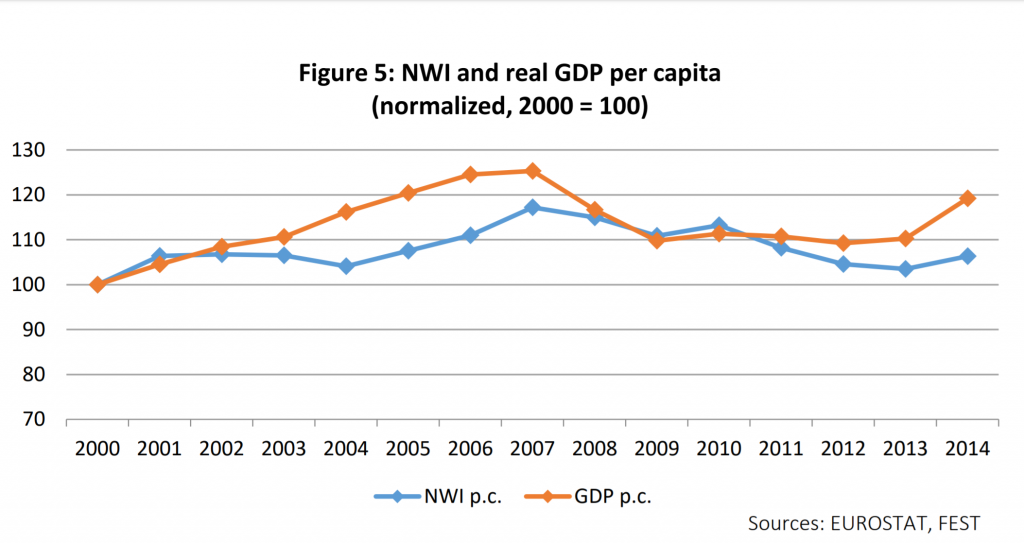
As the chart below shows, this Well-Being
Index (NWI) had a slump in 2004, at a time of economic boom that was as bad as
the worst slump during the recession in 2013. Neither of these slumps, however,
was particularly catastrophic.
Even taking into account the NWI’s
inherent limitations – discussed in a recent Feasta podcast – it seems clear that
the relationship between growth and wellbeing is a highly complex one.
Yet, by arguing that GDP and wellbeing
(or progress) does not directly correlate, this is not to dismiss the risks
presented by recession. They do exist. Moreover, we may well need to deal with
a far deeper and more permanent economic contraction in the future than the
2008 one, and so those risks will be amplified.
Feasta research has shown that certain
‘upstream’ measures could significantly help to increase Irish society’s
resilience during degrowth. These measures include financial system reform, the introduction of a basic income and a shift in taxation away from labour toward
any income that owes its existence to the use of a common good such as the use
of the atmosphere as a carbon
dump, land value and financial speculation.
Such measures need to take into account
the huge variation in responsibility for emissions in society, and the equally
huge variation in the effects of degrowth on different segments of the
population. For example, in both the US and UK, the top 10 per cent of
the population produce at least five times the emissions of the lowest
50 per cent.
These are the people with high discretionary income, in contrast to those on the lower end who may well be in a vulnerable financial state already. So, exactly whose portion of the economy needs to contract the most? The answer seems pretty clear.
Degrowth has chosen us
A final, but extremely important, point
about degrowth – which The Irish Times piece failed to mention – is that
degrowth is going to happen, no matter what we do. This is
because of the close correlation between fossil fuel use and economic growth.
It is well known that easily-accessible
oil is running out and that unconventional oil and gas production is both
highly polluting and inefficient in terms of the net energy it provides. Here
we really are talking about laws of physics rather than social science data.
Even if we completely ignore climate
breakdown, degrowth will still be a reality we need to face. Indeed, it could
well come upon us extremely quickly. Renewables simply can’t replicate the
dazzling efficiency of traditional fossil fuels overnight.
So it’s not a matter of choosing whether
or not to become a ‘degrowth fan’ or to ‘champion’ it. Degrowth has chosen us,
not the other way round. Right now, we may still have a bit of wiggle room in
terms of exactly what kind of degrowth there will be (while we can’t even be
certain even of that, we owe it to younger generations to do the very best
we can).
The sobering fact is that if time
continues to go by without taking measures to mitigate the significant risks
that degrowth presents, our choices will become more and more constrained and
the likelihood of a catastrophic economic crash will become greater and
greater.
And one thing is clear: playing down the
environmental risks we’re facing, while distorting the research into the
effects of recession, doesn’t help to move the debate along.
By Caroline Whyte
Caroline is the research and
communications officer with Feasta – the Foundation for the Economics of
Sustainability, founded in 1998 to explore the economic, cultural and
environmental characteristics of a sustainable society.
The post Growth and degrowth: unpacking the myths appeared first on Green News Ireland.