


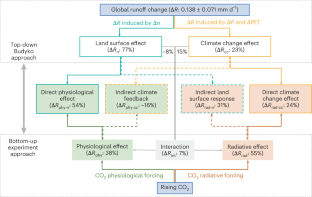
Global runoff increases with carbon dioxide (CO2) concentration because of the synergistic effects of physiological responses to CO2 and the responses of vegetation and soil moisture to CO2-induced climate change. These land surface changes are far more important than the direct effects of climate change on global runoff in a CO2-warmed world.
This is a preview of subscription content, access via your institution
Access options
Access Nature and 54 other Nature Portfolio journals
Get Nature+, our best-value online-access subscription
$29.99 per month
cancel any time
Subscribe to this journal
Receive 12 print issues and online access
$209.00 per year
only $17.42 per issue
Rent or buy this article
Get just this article for as long as you need it
$39.95
Prices may be subject to local taxes which are calculated during checkout
References
-
Yang, Y., Roderick, M. L., Zhang, S., McVicar, T. R. & Donohue, R. J. Hydrologic implications of vegetation response to elevated CO2 in climate projections. Nat. Clim. Change 9, 44–48 (2019). This paper shows that the projected increase in global runoff is mainly caused by vegetation responses to elevated CO2 based on the Budyko framework.
-
Betts, R. A. et al. Projected increase in continental runoff due to plant responses to increasing carbon dioxide. Nature 448, 1037–1041 (2007). This paper reports global runoff increases induced by CO2 radiative and physiological forcing in Earth system models.
-
Zhou, S. et al. A new method to partition climate and catchment effect on the mean annual runoff based on the Budyko complementary relationship. Water Resour. Res. 52, 7163–7177 (2016). This paper provides a Budyko-based attribution method that can exactly decompose runoff changes into the effects of climate and land surface changes.
-
Lian, X. et al. Multifaceted characteristics of dryland aridity changes in a warming world. Nat. Rev. Earth Environ. 2, 232–250 (2021). This review article presents the idea that land surface processes are responsible for the divergence in atmospheric, hydrologic and ecological aridity changes.
Additional information
Publisher’s note Springer Nature remains neutral with regard to jurisdictional claims in published maps and institutional affiliations.
This is a summary of: Zhou, S. et al. Projected increase in global runoff dominated by land surface changes. Nat. Clim. Change https://doi.org/10.1038/s41558-023-01659-8 (2023).
Rights and permissions
About this article
Cite this article
Land surface processes are the dominant driver of global runoff increase.
Nat. Clim. Chang. (2023). https://doi.org/10.1038/s41558-023-01666-9
-
Published: 17 April 2023
-
DOI: https://doi.org/10.1038/s41558-023-01666-9