



Under Alberta securities law, which protect the province’s investors, the company is required to report litigation or investment risks, which could include major oil spills. The amount of disclosure required, said Hilary McMeekin, communications manager for the Alberta Securities Commission, depends on the “severity of the spill.”
“If the incident is of such an extent to be considered material (material is defined as an occurrence, event, or information that is sufficiently significant to influence the share price) there are specific disclosure requirements, as contemplated under the National Instrument 51-102 Continues Disclosure Obligations,” she said via email.
While no trace of the spill’s social or environmental impact could be found in Husky’s annual reports and powerpoint presentations to investors, Duvall said Husky has fulfilled all of its reporting requirements. All relevant information, including spill locations, wildlife casualties and environmental impact, he added, continues to be reported to the appropriate regulators.
“We respect the role of the regulator in this process,” Duvall explained. “We disclose information on spills in our Community Report, which is available to all investors and the public. We comply with all securities reporting regulations and with all rules and regulations governing the industry.
“We also invite media to ask questions on our investor conference calls and we have been open and forthcoming in answering any questions related to the spill.”
The Government of Saskatchewan was unable to comment on whether Husky had fulfilled its reporting and disclosure obligations, as the matter remains under provincial investigation.
“Saskatchewan’s prosecutions branch is currently reviewing the spill incident, and that review would include matters of public notification,” said media relations officer Karen Hill. “We are unable comment on the appropriateness of these actions until that process is complete.”
Without commenting on the Husky Energy in particular, Gaétan Caron, a former chair and CEO of the National Energy Board suggested that if residents are unhappy with a company’s transparency or disclosure on oil spills, their attention should be on the regulator, not necessarily the company. The National Energy Board is Canada’s federal pipeline regulator, and has its own strict compliance rules in the event of an oil spill.
“To whack a company for not doing more than the law requires — that can be satisfying and if I’m an environmental activist, for example who wants to get exposure from the media, I can go very far with that — but I would not choose that mode of action myself.
“The requirement to make data available to citizens must come from a governmental source or the regulator of that jurisdiction.”
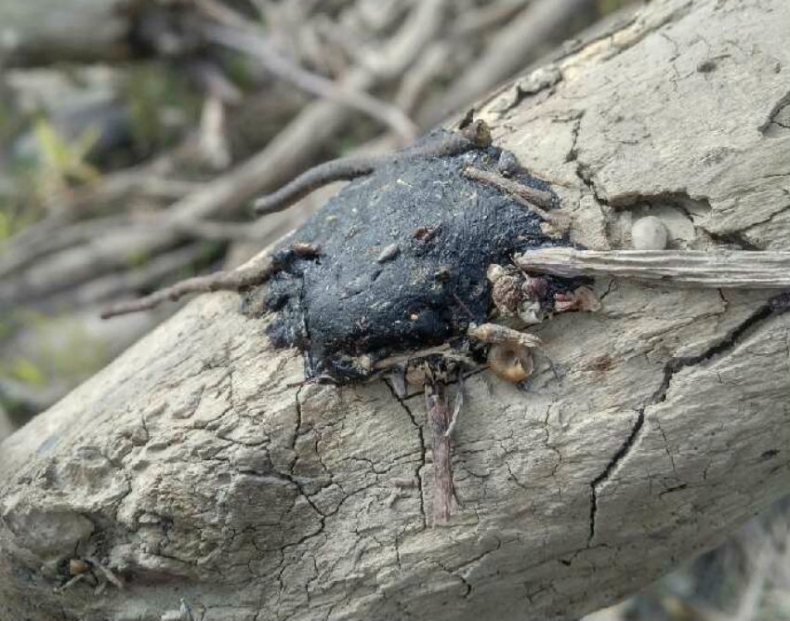
Crusty black stuff started popping up on logs and branches along the shore of the North Saskatchewan River in James Smith Cree Nations after Husky Energy’s pipeline spill on July 21, 2016. Photo courtesy of James Smith Cree Nation
Public has a right to more, says lawyer
MacLean however, suggested that the public has a right to demand “more fulsome disclosure” that aligns with Husky’s own publicly-stated standards of conduct. Since the spill occurred, public requests to have Husky’s pipeline inspection records released by the Saskatchewan government have failed, despite a recommendation to do so from the province’s privacy commissioner.
“If you spill oil into a river, into an ecosystem, on treaty land, you have an ethical obligation to be as forthcoming, upfront, transparent and engaged with stakeholders as you possibly can — short of disclosing competitively sensitive information,” said MacLean.
“That’s an ethical obligation at the very least, and in addition to cleaning it up, taking remedial measures to improve your business and technology to ensure it never happens again.”
How does Husky’s transparency stack up?
According to Saskatchewan’s WSA, all of Husky’s spill monitoring was done on a voluntary basis, and the provincial government did not “compel” the company to release any of its investigation results to the public. Other Canadian oil companies however — also Calgary-based — have voluntarily kept their spill records online, including Enbridge and Nexen.
Press statements, cleanup and compensation updates, along with a timeline events remain on Enbridge’s website more than six years after its pipeline disaster in Michigan. On July 26, 2010, Enbridge’s 30-inch pipeline ruptured, spilling millions of gallons of oil into the Talmadge Creek and Kalamazoo River — creating a cleanup tab of more than US$1 billion.
The company’s corporate social responsibility (CSR) policy places great emphasis on “integrity,” which includes maintaining “truth in all interactions,” and not taking “the easy way out.” In addition, on a web page dedicated to the Kalamazoo oil spill, Enbridge says it “memorialized” the incident to help it ensure such a catastrophe never happens again.
“Immediately following the Line 6B release in July 2010, Enbridge made a promise to the people of south-central Michigan to restore the area, including the Kalamazoo River and Talmadge Creek, as close as possible to its pre-spill condition,” it says.
“We continue to honor that promise. As a company, we have memorialized the Marshall release — to guide our decisions, and strengthen our resolve to prevent such an event from ever happening again.”
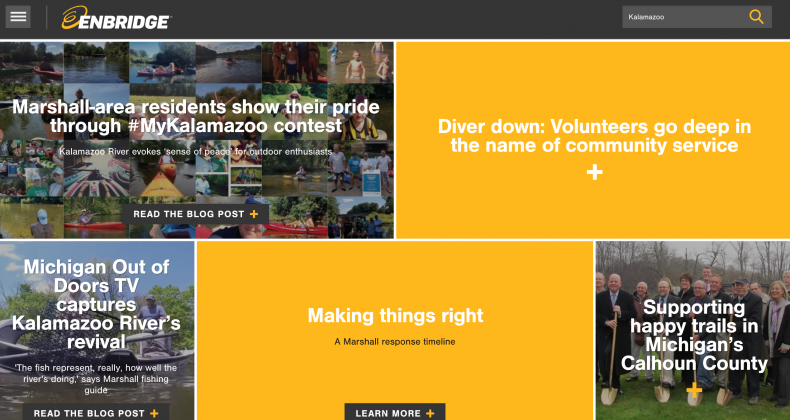 A screenshot of Enbridge’s web section dedicated to the July 2010 oil spill in the Kalamazoo River in Michigan demonstrates the company’s transparency on the spill. Screenshot by National Observer
Nexen Energy, whose July 2015 pipelines spill near southeast of Fort McMurray was one of the largest in Alberta’s history, has also kept press statements and cleanup updates online. Its sustainability performance report for that year mentions the spill directly, and the company’s effort to minimize its impact on the environment and wildlife.
Nexen did not respond to requests for comment on this story, but its online corporate social responsibility (CSR) page emphasizes the importance of “transparent reporting.”
“We build long-term trust by sharing information, consulting with stakeholders about business decisions and working collaboratively to understand their needs and expectations,” says the website. “In addition to our annual update on our sustainability performance, we also benchmark our performance against the industry’s best.”
Walking the CSR talk
MacLean said he applauds the companies that actually “walk the CSR talk,” but suggested that this is the exception rather than the rule. So can a company be sued for violating its own principles of business ethics?
The law is a “moving target” in that area, he explained. For the moment, he didn’t think a legal argument could be made that Husky breached its disclosure duty to the public, but “I think the law is going there,” he said.
Husky, meantime, has adopted several measures to ensure such an incident never happens again. At the embattled 16TAN pipeline near Maidstone, it has installed inclinometers to measure ground angles and increased the frequency of geotechnical surveys and in-line inspections. The company will use fibre optic cable alongside the pipeline, provide real-time measurements of temperature, strain and acoustics, and use a higher grade of steel and thicker wall pipe on the section currently under repair.
“We know this event had an impact on communities and First Nations downstream, and we worked closely with all groups and regulators throughout on a coordinated response,” said Duvall. “We are grateful for the support and cooperation we received and continue to receive from these communities.”
The Canadian Energy Pipeline Association, which declined to comment on this story also wrote in its 2017 performance report that “safety, environmental protection and emergy response are, and always have been our top priorities.”
“Through CEPA, members work together to continuously improve in key areas to reach our goal of zero incidents.”