


Abstract
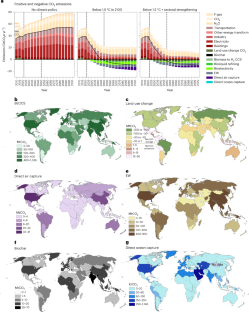
Carbon dioxide removal (CDR) is a critical tool in all plans to limit warming to below 1.5 °C, but only a few CDR pathways have been incorporated into integrated assessment models that international climate policy deliberations rely on. A more diverse set of CDR approaches could have important benefits and costs for energy–water–land systems. Here we use an integrated assessment model to assess a complete suite of CDR approaches including bioenergy with carbon capture and storage, afforestation, direct air capture with carbon storage, enhanced weathering, biochar and direct ocean capture with carbon storage. CDR provided by each approach spans three orders of magnitude, with deployment and associated impacts varying between regions. Total removals reach approximately 10 GtCO2 yr−1 globally, largely to offset residual CO2 and non-CO2 emissions, which remain costly to avoid even under scenarios specifically designed to reduce them.
This is a preview of subscription content, access via your institution
Access options
Access Nature and 54 other Nature Portfolio journals
Get Nature+, our best-value online-access subscription
$29.99 per month
cancel any time
Subscribe to this journal
Receive 12 print issues and online access
$209.00 per year
only $17.42 per issue
Rent or buy this article
Get just this article for as long as you need it
$39.95
Prices may be subject to local taxes which are calculated during checkout


Data availability
All model output data for this study are available in a public repository accessible at https://doi.org/10.5281/zenodo.7492895.
Code availability
GCAM is an open-source community model available at https://github.com/JGCRI/gcam-core/releases. The particular version of GCAM, additional input files and data-processing scripts associated with this study are available at https://doi.org/10.5281/zenodo.7492895.
References
-
IPCC Climate Change 2022: Mitigation of Climate Change (eds Shukla, P. R. et al.) (Cambridge Univ. Press, 2022).
-
Iyer, G. et al. The role of carbon dioxide removal in net-zero emissions pledges. Energy Clim. Change 2, 100043 (2021).
-
Kriegler, E. et al. Pathways limiting warming to 1.5 °C: a tale of turning around in no time? Phil. Trans. R. Soc. A 376, 20160457 (2018).
-
Davis, S. J. et al. Net-zero emissions energy systems. Science 360, eaas9793 (2018).
-
Luderer, G. et al. Residual fossil CO2 emissions in 1.5–2 °C pathways. Nat. Clim. Change 8, 626–633 (2018).
-
Ou, Y. N. et al. Can updated climate pledges limit warming well below 2 °C? Science 374, 693–695 (2021).
-
Meinshausen, M. et al. Realization of Paris Agreement pledges may limit warming just below 2 °C. Nature 604, 304–309 (2022).
-
Glasgow Climate Pact (UNFCCC, 2021).
-
Emissions Gap Report 2021 (UNEP, 2021); https://www.unep.org/resources/emissions-gap-report-2021
-
Iyer, G. et al. Ratcheting of climate pledges needed to limit peak global warming. Nat. Clim. Change https://doi.org/10.1038/s41558-022-01508-0 (2022).
-
Wiese, L. et al. Countries’ commitments to soil organic carbon in Nationally Determined Contributions. Clim. Policy https://doi.org/10.1080/14693062.2021.1969883 (2021).
-
Net Zero: The UK’s Contribution to Stopping Global Warming (Committee on Climate Change, 2019).
-
Wiltshire, A. J., Randow, C., Rosan, T. M., Tejada, G. & Castro, A. A. Understanding the role of land-use emissions in achieving the Brazilian Nationally Determined Contribution to mitigate climate change. Clim. Resil. Sustain. 1, e31 (2022).
-
NDC Registry (UNFCCC, 2022); https://www4.unfccc.int/sites/NDCStaging/Pages/LatestSubmissions.aspx
-
The Long-Term Strategy of the United States: Pathways to Net-Zero Greenhouse Gas Emissions by 2050 (US Department of State and US Executive Office of the President, 2021).
-
Roe, S. et al. Contribution of the land sector to a 1.5 °C world. Nat. Clim. Change 9, 817–828 (2019).
-
Joppa, L. et al. Microsoft’s million-tonne CO2-removal purchase—lessons for net zero. Nature 597, 629–632 (2021).
-
Energy Act of 2020 (116th United States Congress, 2020).
-
Goll, D. S. et al. Potential CO2 removal from enhanced weathering by ecosystem responses to powdered rock. Nat. Geosci. 148, 545–549 (2021).
-
Kantzas, E. P. et al. Substantial carbon drawdown potential from enhanced rock weathering in the United Kingdom. Nat. Geosci. 15, 382–389 (2022).
-
Digdaya, I. A. et al. A direct coupled electrochemical system for capture and conversion of CO2 from oceanwater. Nat. Commun. 11, 4412 (2020).
-
Schmidt, H. P. et al. Pyrogenic carbon capture and storage. GCB Bioenergy 11, 573–591 (2019).
-
Minx, J. C. et al. Negative emissions—Part 1: Research landscape and synthesis. Environ. Res. Lett. 13, 063001 (2018).
-
Fuss, S. Negative emissions—Part 2: Costs, potentials and side effects. Environ. Res. Lett. 13, 063002 (2018).
-
Nemet, G. F. et al. Negative emissions—part 3: innovation and upscaling. Environ. Res. Lett. 13, 063003 (2018).
-
Buck, H. J., Fuhrman, J., Morrow, D. R., Sanchez, D. L. & Wang, F. M. Adaptation and carbon removal. One Earth 3, 425–435 (2020).
-
Smith, P. et al. Biophysical and economic limits to negative CO2 emissions. Nat. Clim. Change 6, 42–50 (2016).
-
Edenhofer, O. et al. Between Scylla and Charybdis: delayed mitigation narrows the passage between large-scale CDR and high costs. Environ. Res. Lett. 13, 044015 (2018).
-
Realmonte, G. et al. An inter-model assessment of the role of direct air capture in deep mitigation pathways. Nat. Commun. 10, 3277 (2019).
-
Chen, C. & Tavoni, M. Direct air capture of CO2 and climate stabilization: a model based assessment. Climatic Change 118, 59–72 (2013).
-
Marcucci, A., Kypreos, S. & Panos, E. The road to achieving the long-term Paris targets: energy transition and the role of direct air capture. Climatic Change 144, 181–193 (2017).
-
Fuhrman, J., McJeon, H., Doney, S. C., Shobe, W. & Clarens, A. F. From zero to hero? Why integrated assessment modeling of negative emissions technologies is hard and how we can do better. Front. Clim. 1, 11 (2019).
-
Wise, M. et al. Implications of limiting CO2 concentrations for land use and energy. Science 324, 1183–1186 (2009).
-
Fuhrman, J. et al. Food–energy–water implications of negative emissions technologies in a +1.5 °C future. Nat. Clim. Change 10, 920–927 (2020).
-
Fuhrman, J. et al. The role of direct air capture and negative emissions technologies in the Shared Socioeconomic Pathways towards +1.5 °C and +2 °C futures. Environ. Res. Lett. 16, 11 (2021).
-
Hejazi, M. I. et al. 21st century United States emissions mitigation could increase water stress more than the climate change it is mitigating. Proc. Natl. Acad. Sci. USA 112, 10635–10640 (2015).
-
Strefler, J. et al. Alternative carbon price trajectories can avoid excessive carbon removal. Nat. Commun. 12, 22264 (2021).
-
Holz, C., Siegel, L. S., Johnston, E., Jones, A. P. & Sterman, J. Ratcheting ambition to limit warming to 1.5 °C-trade-offs between emission reductions and carbon dioxide removal. Environ. Res. Lett. 13, 064028 (2018).
-
Calvin, K. et al. GCAM v5.1: representing the linkages between energy, water, land, climate, and economic systems. Geosci. Model Dev. 12, 677–698 (2019).
-
Paris Agreement (UNFCCC, 2015).
-
Bauer, N. et al. Shared Socio-economic Pathways of the energy sector—quantifying the narratives. Glob. Environ. Change 42, 316–330 (2017).
-
Muratori, M., Calvin, K., Wise, M., Kyle, P. & Edmonds, J. Global economic consequences of deploying bioenergy with carbon capture and storage (BECCS). Environ. Res. Lett. 11, 095004 (2016).
-
Muratori, M. et al. Carbon capture and storage across fuels and sectors in energy system transformation pathways. Int. J. Greenh. Gas Control 57, 34–41 (2017).
-
Pradhan, S. et al. Effects of direct air capture technology availability on stranded assets and committed emissions in the power sector. Front. Clim. 3, 660787 (2021).
-
Fuhrman, J. et al. The role of negative emissions in meeting China’s 2060 carbon neutrality goal. Oxf. Open Clim. Change 1, 1–15 (2021).
-
Bergero, C., Wise, M. A., Lamers, P., Wang, Y. & Weber, M. Impacts of biochar on carbon management and ecosystem services in the integrated context of agriculture and energy systems. Preprint at Research Square https://doi.org/10.21203/rs.3.rs-1805544/v1 (2022).
-
Gambhir, A. et al. Near-term transition and longer-term physical climate risks of greenhouse gas emissions pathways. Nat. Clim. Change 12, 88–96 (2022).
-
Monteith, S. & Menon, S. Achieving Global Climate Goals by 2050: Actionable Opportunities for This Decade (ClimateWorks Foundation, 2020); https://www.climateworks.org/report/achieving-global-climate-goals-by-2050-actionable-opportunities-for-this-decade/
-
Jeffery, S. et al. Biochar boosts tropical but not temperate crop yields. Environ. Res. Lett. 12, 053001 (2017).
-
Byers, E. et al. AR6 Scenario Explorer and Database Hosted by IIASA (International Institute for Applied Systems Analysis, 2022).
-
Jackson, R. B., Solomon, E. I., Canadell, J. G., Cargnello, M. & Field, C. B. Methane removal and atmospheric restoration. Nat. Sustain. 2, 436–438 (2019).
-
Ou, Y. et al. Deep mitigation of CO2 and non-CO2 greenhouse gases toward 1.5 °C and 2 °C futures. Nat. Commun. 12, 6245 (2021).
-
Strefler, J. et al. Carbon dioxide removal technologies are not born equal. Environ. Res. Lett. 16, 074021 (2021).
-
Bertagni, M. B. & Porporato, A. The carbon-capture efficiency of natural water alkalinization: implications for enhanced weathering. Sci. Total Environ. 838, 156524 (2022).
-
Buckingham, F., Henderson, G., Holdship, P. & Renforth, P. Soil core study indicates limited CO2 removal by enhanced weathering in dry croplands in the UK. Appl. Geochem. https://doi.org/10.1016/j.apgeochem.2022.105482 (2022).
-
Rengel, Z. Soil pH, soil health and climate change. In Singh, B., Cowie, A. & Chan, K. (eds) Soil Health and Climate Change. Soil Biology, vol 29. 69–85 (Springer, 2011); https://doi.org/10.1007/978-3-642-20256-8_4
-
Coal 2020 (IEA, 2020).
-
Qiu, Y. et al. Environmental trade-offs of direct air capture technologies in climate change mitigation toward 2100. Nat. Commun. 13, 3635 (2022).
-
Udall, B. & Overpeck, J. The twenty-first century Colorado River hot drought and implications for the future. Water Resour. Res. 53, 2404–2418 (2017).
-
Milly, P. C. & Dunne, K. Colorado River flow dwindles as warming-driven loss of reflective snow energizes evaporation. Science https://doi.org/10.1126/science.aay9187 (2020).
-
Zetland, D. The role of prices in managing water scarcity. Water Secur. 12, 100081 (2021).
-
Negative Emissions Technologies and Reliable Sequestration (National Academies of Sciences Engineering and Medicine, 2019); https://doi.org/10.17226/25259
-
Griscom, B. W. et al. Natural climate solutions. Proc. Natl. Acad. Sci. USA 114, 11645–11650 (2017).
-
Janzen, H. H., van Groenigen, K. J., Powlson, D. S., Schwinghamer, T. & van Groenigen, J. W. Photosynthetic limits on carbon sequestration in croplands. Geoderma 416, 115810 (2022).
-
Leifeld, J. & Menichetti, L. The underappreciated potential of peatlands in global climate change mitigation strategies. Nat. Commun. 9, 1071 (2018).
-
Sendi, M., Bui, M., Mac Dowell, N. & Fennell, P. Geospatial analysis of regional climate impacts to accelerate cost-efficient direct air capture deployment. One Earth 5, 1153–1164 (2022).
-
Iyer, G. et al. Diffusion of low-carbon technologies and the feasibility of long-term climate targets. Technol. Forecast. Soc. Change 90, 103–118 (2015).
-
Iyer, G. C. et al. The contribution of Paris to limit global warming to 2 °C. Environ. Res. Lett. 10, 125002 (2015).
-
Di Vittorio, A. V., Vernon, C. R. & Shu, S. Moirai version 3: a data processing system to generate recent historical land inputs for global modeling applications at various scales. J. Open Res. Softw. 8, 1–11 (2020).
-
Turner, S. W. D., Hejazi, M., Yonkofski, C., Kim, S. H. & Kyle, P. Influence of groundwater extraction costs and resource depletion limits on simulated global nonrenewable water withdrawals over the twenty-first century. Earth’s Future 7, 123–135 (2019).
-
Liu, Y., Hejazi, M., Li, H., Zhang, X. & Leng, G. A hydrological emulator for global applications—HE v1.0.0. Geosci. Model Dev. 11, 1077–1092 (2018).
-
Sinha, E. et al. Implication of imposing fertilizer limitations on energy, agriculture, and land systems. J. Environ. Manage. 305, 114391 (2022).
-
Kim, S. H. et al. Balancing global water availability and use at basin scale in an integrated assessment model. Climatic Change 136, 217–231 (2016).
-
Vernon, C. R. et al. Demeter—a land use and land cover change disaggregation model. J. Open Res. Softw. 6, 15 (2018).
-
Le Page, Y., West, T. O., Link, R. & Patel, P. Downscaling land use and land cover from the Global Change Assessment Model for coupling with Earth system models. Geosci. Model Dev. 9, 3055–3069 (2016).
-
Li, X. et al. Tethys—a Python package for spatial and temporal downscaling of global water withdrawals. J. Open Res. Softw. 6, 9 (2018).
-
Khan, Z. et al. A global gridded monthly water withdrawal dataset for multiple sectors from 2015 to 2100 at 0.5° resolution under a range of socioeconomic and climate scenarios. EGU General Assembly https://doi.org/10.5194/EGUSPHERE-EGU21-903 (2021).
-
Chen, M. et al. Global land use for 2015–2100 at 0.05° resolution under diverse socioeconomic and climate scenarios. Sci. Data 7, 320 (2020).
-
Hejazi, M. I. et al. Integrated assessment of global water scarcity over the 21st century under multiple climate change mitigation policies. Hydrol. Earth Syst. Sci. 18, 2859–2883 (2014).
-
Calvin, K. et al. Trade-offs of different land and bioenergy policies on the path to achieving climate targets. Climatic Change 123, 691–704 (2014).
-
Luckow, P., Wise, M. A., Dooley, J. J. & Kim, S. H. Large-scale utilization of biomass energy and carbon dioxide capture and storage in the transport and electricity sectors under stringent CO2 concentration limit scenarios. Int. J. Greenh. Gas Control 4, 865–877 (2010).
-
Popp, A. et al. Land-use transition for bioenergy and climate stabilization: model comparison of drivers, impacts and interactions with other land use based mitigation options. Climatic Change 123, 495–509 (2014).
-
Kyle, P. et al. Influence of climate change mitigation technology on global demands of water for electricity generation. Int. J. Greenh. Gas Control 13, 112–123 (2013).
-
Lehne, J., Yu, S., Blahut, N. & Charles, M. 1.5C Steel: Decarbonising the Steel Sector in Paris-Compatible Pathways (E3G, 2021).
-
H2A: Hydrogen Analysis Production Models (NREL, 2018).
-
GCAM v.5.4 (JGCRI, 2021).
-
GCAM v.5.4 Documentation http://jgcri.github.io/gcam-doc/ (JGCRI, 2022).
-
Schuiling, R. D. & Krijgsman, P. Enhanced weathering: an effective and cheap tool to sequester CO2. Climatic Change 74, 349–354 (2006).
-
Goddéris, Y. et al. Onset and ending of the late Palaeozoic ice age triggered by tectonically paced rock weathering. Nat. Geosci. 10, 382–386 (2017).
-
Walker, J. C. G., Hays, P. B. & Kasting, J. F. A negative feedback mechanism for the long-term stabilization of Earth’s surface temperature. J. Geophys. Res. 86, 9776–9782 (1981).
-
Renforth, P. The negative emission potential of alkaline materials. Nat. Commun. 10, 1401 (2019).
-
Hartmann, J. et al. Enhanced chemical weathering as a geoengineering strategy to reduce atmospheric carbon dioxide, supply nutrients, and mitigate ocean acidification. Rev. Geophys. 51, 113–149 (2013).
-
Beerling, D. J. et al. Potential for large-scale CO2 removal via enhanced rock weathering with croplands. Nature 583, 242–248 (2020).
-
Amann, T. et al. Enhanced weathering and related element fluxes—a cropland mesocosm approach. Biogeosciences 17, 103–119 (2020).
-
Renforth, P., Pogge von Strandmann, P. A. E. & Henderson, G. M. The dissolution of olivine added to soil: implications for enhanced weathering. Appl. Geochem. 61, 109–118 (2015).
-
Kriegler, E., Bauer, N., Strefler, J., Hartmann, J. & Amann, T. Potential and costs of carbon dioxide removal by enhanced weathering of rocks. Environ. Res. Lett. 13, 034010 (2018).
-
Keith, D. W., Holmes, G., St. Angelo, D. & Heidel, K. A process for capturing CO2 from the atmosphere. Joule 2, 1573–1594 (2018).
-
Fasihi, M., Efimova, O. & Breyer, C. Techno-economic assessment of CO2 direct air capture plants. J. Clean. Prod. 224, 957–980 (2019).
-
Beuttler, C., Charles, L. & Wurzbacher, J. The role of direct air capture in mitigation of anthropogenic greenhouse gas emissions. Front. Clim. https://doi.org/10.3389/fclim.2019.00010 (2019).
-
Beerling, D. J. et al. Farming with crops and rocks to address global climate, food and soil security. Nat. Plants 4, 138–147 (2018).
-
Kantola, I. B., Masters, M. D., Beerling, D. J., Long, S. P. & DeLucia, E. H. Potential of global croplands and bioenergy crops for climate change mitigation through deployment for enhanced weathering. Biol. Lett. 13, 20160714 (2017).
-
Taylor, L. L. et al. Enhanced weathering strategies for stabilizing climate and averting ocean acidification. Nat. Clim. Change 6, 402–406 (2016).
-
Smith, P. et al. Land-management options for greenhouse gas removal and their impacts on ecosystem services and the Sustainable Development Goals. Annu. Rev. Environ. Resour. 44, 255–286 (2019).
-
Strefler, J., Amann, T., Bauer, N., Kriegler, E. & Hartmann, J. Potential and costs of carbon dioxide removal by enhanced weathering of rocks. Environ. Res. Lett. 13, 034010 (2018).
-
Dooley, J. J., Kim, S. H., Edmonds, J. A., Friedman, S. J. & Wise, M. A. A first-order global geological CO2-storage potential supply curve and its application in a global integrated assessment model. Greenh. Gas Control Technol. https://doi.org/10.1016/B978-008044704-9/50058-6 (2005).
-
DeVries, T., Holzer, M. & Primeau, F. Recent increase in oceanic carbon uptake driven by weaker upper-ocean overturning. Nature 542, 215–218 (2017).
-
Khatiwala, S. et al. Global ocean storage of anthropogenic carbon. Biogeosciences 10, 2169–2191 (2013).
-
Devries, T. The oceanic anthropogenic CO2 sink: storage, air–sea fluxes, and transports over the industrial era. Glob. Biogeochem. Cycles 28, 631–647 (2014).
-
Patterson, B. D. et al. Renewable CO2 recycling and synthetic fuel production in a marine environment. Proc. Natl. Acad. Sci. USA 116, 12212–12219 (2019).
-
Eisaman, M. D. et al. Indirect ocean capture of atmospheric CO2: part II. Understanding the cost of negative emissions. Int. J. Greenh. Gas Control 70, 254–261 (2018).
-
Davies, P. A., Yuan, Q. & De Richter, R. Desalination as a negative emissions technology. Environ. Sci. Water Res. Technol. 4, 839–850 (2018).
-
Liu, Y. et al. Global and regional evaluation of energy for water. Environ. Sci. Technol. 50, 9736–9745 (2016).
-
Woolf, D., Amonette, J. E., Street-Perrott, F. A., Lehmann, J. & Joseph, S. Sustainable biochar to mitigate global climate change. Nat. Commun. 1, 56 (2010).
-
Smith, P. Soil carbon sequestration and biochar as negative emission technologies. Glob. Change Biol. 22, 1315–1324 (2016).
-
Jeffery, S., Verheijen, F. G. A., van der Velde, M. & Bastos, A. C. A quantitative review of the effects of biochar application to soils on crop productivity using meta-analysis. Agric. Ecosyst. Environ. 144, 175–187 (2011).
-
Borchard, N. et al. Biochar, soil and land-use interactions that reduce nitrate leaching and N2O emissions: a meta-analysis. Sci. Total Environ. 651, 2354–2364 (2019).
-
Razzaghi, F., Obour, P. B. & Arthur, E. Does biochar improve soil water retention? A systematic review and meta-analysis. Geoderma 361, 114055 (2020).
-
Roberts, K. G., Gloy, B. A., Joseph, S., Scott, N. R. & Lehmann, J. Life cycle assessment of biochar systems: estimating the energetic, economic, and climate change potential. Environ. Sci. Technol. 44, 827–833 (2010).
-
Woolf, D., Lehmann, J., Fisher, E. M. & Angenent, L. T. Biofuels from pyrolysis in perspective: trade-offs between energy yields and soil-carbon additions. Environ. Sci. Technol. 48, 6492–6499 (2014).
-
Lehmann, J. et al. Biochar in climate change mitigation. Nat. Geosci. 14, 883–892 (2021).
-
Wang, Y. et al. Estimating carbon emissions from the pulp and paper industry: a case study. Appl. Energy 184, 779–789 (2016).
-
Woolf, D., Lehmann, J. & Lee, D. R. Optimal bioenergy power generation for climate change mitigation with or without carbon sequestration. Nat. Commun. 7, 13160 (2016).
-
Canadell, J. G. & Schulze, E. D. Global potential of biospheric carbon management for climate mitigation. Nat. Commun. 5, 5282 (2014).
-
Doelman, J. C. et al. Afforestation for climate change mitigation: potentials, risks and trade-offs. Glob. Change Biol. 26, 1576–1591 (2020).
-
van Vuuren, D. P. et al. Energy, land-use and greenhouse gas emissions trajectories under a green growth paradigm. Glob. Environ. Change 42, 237–250 (2017).
-
Lane, J., Greig, C. & Garnett, A. Uncertain storage prospects create a conundrum for carbon capture and storage ambitions. Nat. Clim. Change 11, 925–936 (2021).
-
Global Average Near Surface Temperatures Relative to the Pre-industrial Period (Environment European Agency, 2022); https://www.eea.europa.eu/data-and-maps/daviz/global-average-air-temperature-anomalies-5#tab-dashboard-02
-
Fuhrman, J. et al. Replication data and code for: diverse carbon removal approaches could reduce energy–water–land impacts. Zenodo https://doi.org/10.5281/zenodo.7492895 (2022).
Acknowledgements
This research was supported by the ClimateWorks Foundation (J.F., S.M., F.M.W. and H.M.), the Alfred P. Sloan Foundation (A.F.C., S.C.D. and W.S.) and the University of Virginia Environmental Resilience Institute (A.F.C., S.C.D. and W.S.).
Author information
Authors and Affiliations
Contributions
J.F., S.M., F.M.W., A.F.C., S.C.D., W.S. and H.M. designed the research. J.F. led the modelling and wrote the first draft of the paper. J.F., C.B., M.W. and H.M. contributed to the modelling tools. All authors contributed to writing the paper.
Corresponding author
Correspondence to
Haewon McJeon.
Ethics declarations
Competing interests
The authors declare no competing interests.
Peer review
Peer review information
Nature Climate Change thanks Holly Jean Buck and the other, anonymous, reviewer(s) for their contribution to the peer review of this work.
Additional information
Publisher’s note Springer Nature remains neutral with regard to jurisdictional claims in published maps and institutional affiliations.
Supplementary information
Supplementary Information
Supplementary Figs. 1–12, Tables 1–11 and discussion to accompany figures and tables.
Rights and permissions
Springer Nature or its licensor (e.g. a society or other partner) holds exclusive rights to this article under a publishing agreement with the author(s) or other rightsholder(s); author self-archiving of the accepted manuscript version of this article is solely governed by the terms of such publishing agreement and applicable law.
About this article
Cite this article
Fuhrman, J., Bergero, C., Weber, M. et al. Diverse carbon dioxide removal approaches could reduce impacts on the energy–water–land system.
Nat. Clim. Chang. (2023). https://doi.org/10.1038/s41558-023-01604-9
-
Received: 23 August 2022
-
Accepted: 12 January 2023
-
Published: 09 March 2023
-
DOI: https://doi.org/10.1038/s41558-023-01604-9