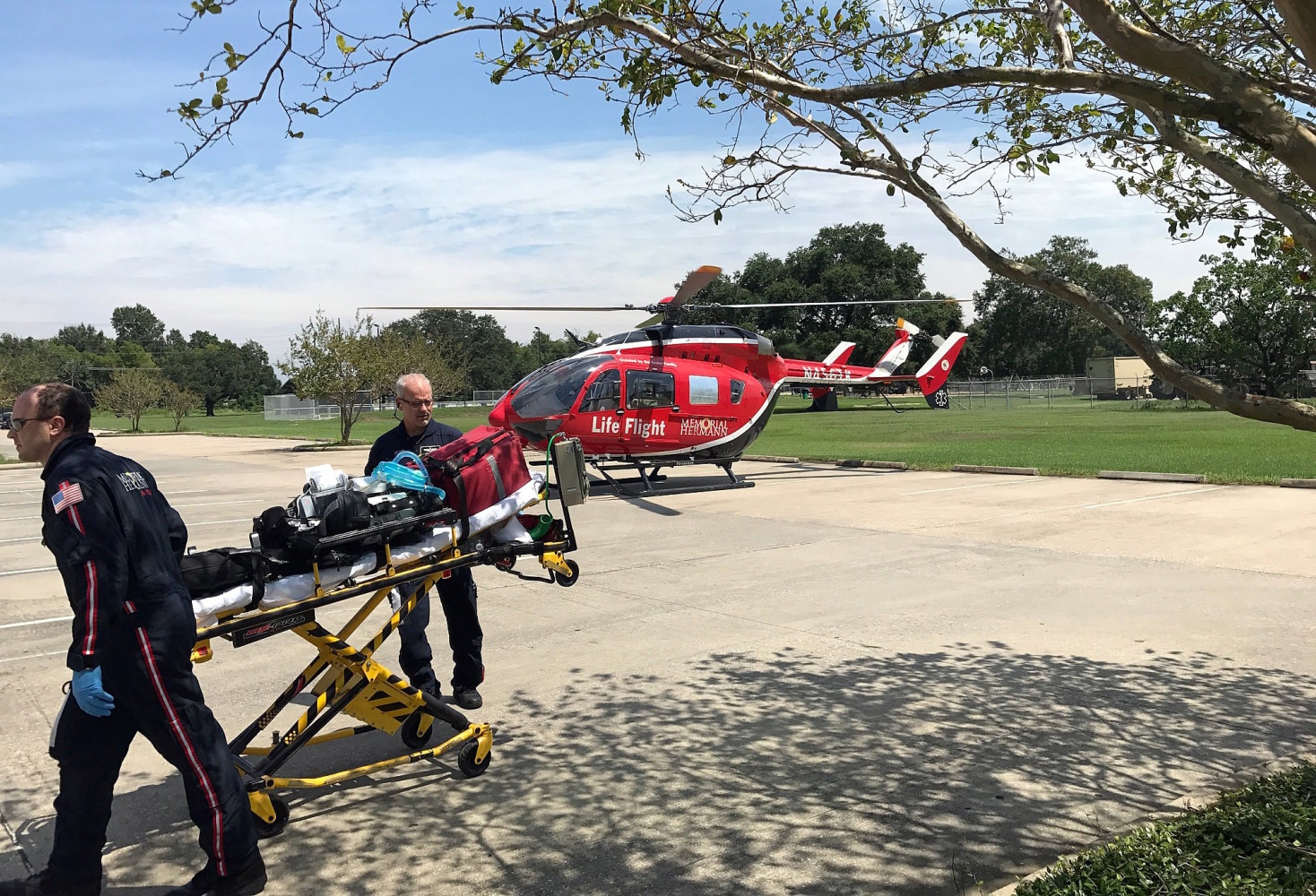


Life Flight, a critical care air medical transport service is seen assisting evacuation due to lack of running water at the Baptist Beaumont Hospital, in Beaumont, Texas on Aug. 31, 2017. Mica Rosenberg / Reuters
“It’s not one person, one program, one department that can do it alone,” he said. Serino says state authorities have improved their response. “They’ve been able so far to inspire the public,” he said.
But experts agreed that the jury is still out on the medical response to Harvey.
“It’s still too early to tell how the response to Harvey is going,” said Dr. Gabor Kelen, director of emergency medicine at Johns Hopkins Medicine and of the Office of Critical Event Preparedness and Response.
“The federal, state and local response appears to be taking a more proactive approach from previous storms of similar magnitude. We haven’t been hearing the same high volume of frustration that we encountered in 2005 in the wake of Hurricane Katrina.”
Related:
Obama Speaks 10 Years After Katrina
A lot will depend on what’s found as Harvey’s floodwaters recede.
“First, are we doing things that will minimize fatalities? Are the specific lifesaving strategies working?” Redlener asked.
More than
1,800 people died in Katrina, and many bodies were found in the attics and front rooms of flooded homes, some months after the storm.
“I don’t know what the final fatalities numbers are,” Redlener said.
“We see houses submerged to the roof. Where are the families? Are they OK? Did they evacuate? Did they drown? We just don’t know.”