

February 7th, 2018
The Government today opposed a Bill stop the State from issuing any new licenses for the exploration and extraction of fossil fuels in Ireland.
The Climate Emergency Measures Bill seeks to stop the government from issuing any new licenses for the exploration and extraction of fossil fuels in the State, both onshore and offshore.
Speaking before the Dail this evening, the Minister of State with responsibility for Natural Resources Sean Kyne said that the Government “must oppose the Bill today” .
With the Government’s opposition, the Bill will now go to a full vote, which is expected to take place in the Dail by lunchtime tomorrow.
There are currently over 40 licenses granted for a range of fossil fuel already, some of which have contracts up to the late 2020s.
People Before Profit (PBP) Deputy Brid Smith, who introduced the Bill last November, said that the Bill iis fullyin line with existing Government policy and called for the cabinet to “get their priorities in place”.
She added: “If we take the Paris Climate Agreement seriously the Oireachtas will support this Bill. If we take the National Transition Objective seriously we will support this Bill. If we take the National Mitigation Plan seriously, we will support this Bill.”
Support The Climate Emergency Bill
People Before Profit TD is putting forward a climate emergency bill- the bill is supported by many climate campaigners including Friends Of The Earth, Not Here Not Anywhere, Trocaire and experts in the field. Contact your local TD to demand they support this important bill.
Posted by People Before Profit on Thursday, 25 January 2018
She called on the Government to be a world leader on this issue and join Costa Rica and France in banning the exploration of fossil fuels.
Last December, France passed a law which will permanently ban the exploration and extraction of fossil fuels nationwide by 2040. In 2014, Costa Rica extended a moratorium on all petroleum exploration and extraction until at least 2021.
“Stopping new exploration is the very first step needed considering that 80 per cent of proved reserves need to be left in the ground if we are to have any hope of keeping temperature rises to under 2 degrees,” Ms Smith added.
Under the Paris Climate Agreement, Ireland has committed to holding the increase in the global temperature increase to well below 2C above pre industrial levels.
Support from opposition parties
The Bill was supported by various independent TDs and all opposition parties, including Fianna Fail, as confirmed by Deputy Timmy Dooley in a social media post earlier this week. Mr Dooley told the Dail this evening that the Bill is needed to address the “climate change crisis unfolding across the world”.
He warned that the burden on societies around the world will be “unprecedented” without action from all nations, adding that we would be committing “moral negligence” if we continue with business as usual.
Fianna Fáil will be supporting the bill! https://t.co/6piU2g7Z8B
— Timmy Dooley TD (@timmydooley) February 6, 2018
While outlined their support for the Bill in principle, several opposition politicians outlined a need to amend the Bill at Committee Stage to ensure we produce energy security at home before a complete ban would come into effect. According to the Sustainable Energy Authority of Ireland, 85 per cent of Irish energy is imported in 2016, with 91 per cent of this coming from fossil fuels.
Fine Gael TD, and Chairperson of the Joint Committee on Climate Action, Hildegarde Naughton said that she would prefer for the legislation to be examined by the Committee rather than proceeding to detailed scrutiny by the same Committee.
[embedded content]
NGO Reaction
The Bill received supported from all opposition parties as well as NGOs such as Trocaire, Not Here Not Anywhere and Friends of the Earth Ireland.
Prior to the vote Stop Climate Chaos (SCC), a coalition of aid agencies and environmental, youth and faith groups, called on the Government to join the cross-party consensus to support the Bill.
SCC argue that any continued exploration and extraction of fossil fuels runs the risk of the state “locking in” for the burning of fossil fuels when the state is already failing in its climate change commitments.
Jerry MacEvilly, SCC Policy Coordinator, said that the coalition’s research shows that Ireland’s energy security does not depend on Irish gas and oil. “To increase our energy security we are far better off investing in local renewables and warmer homes that use less fuel,” Mr MacEvilly said.
Oisin Coghlan, Director of Friends of the Earth, added that we have a chance to take another step towards climate leadership and follow the decision to ban fracking last year.
“We know the Taoiseach would like to seen as the Irish Macron. Well France has already taken this step. Today Leo has a choice, back the Bill or get left behind,” he added.
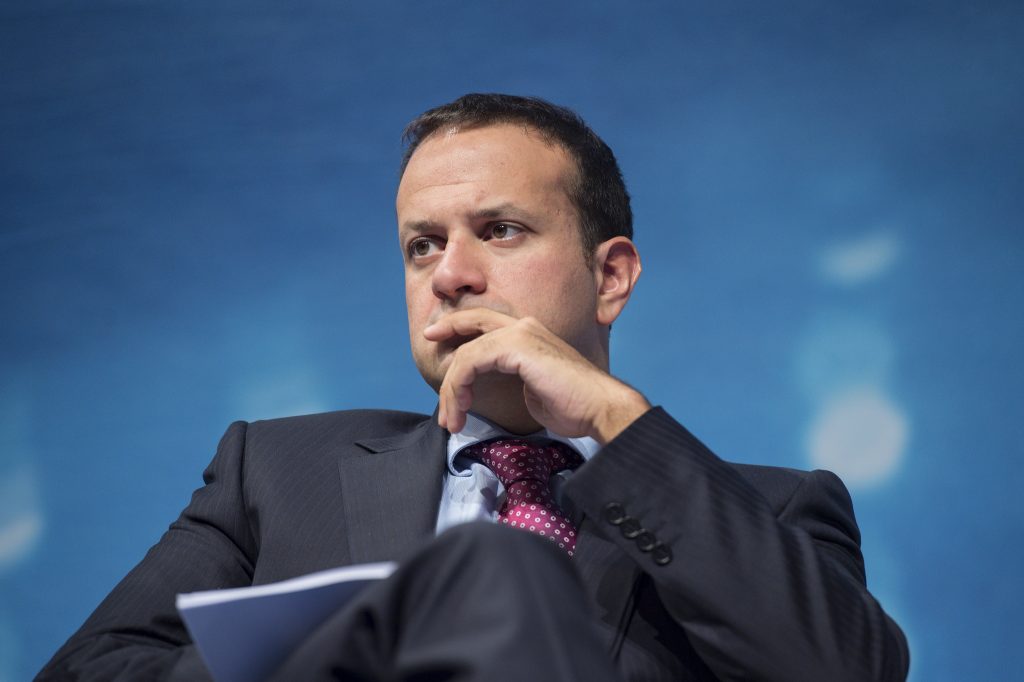
Leo Varadkar at Transport for Growth: Developing Connectivity at the 2012 Summit in Leipzig, Germany on 3 May 2012 Photo: International Transport Forum
Taoiseach’s words must lead to action
Speaking in the European Parliament last month, Taoiseach Leo Varadkar acknowledged that Ireland is falling behind the rest of Europe on tackling climate change and gave his commitment to taking greater action.
“As far as I am concerned, we are a laggard. I am not proud of Ireland’s performance on climate change,” he said. “There are lots of things that we intend to do so that we can meet those [emissions] targets. And it’s something that I am very committed to, and certainly, my generation of politicians is very committed to.”
While welcoming such statements, An Taisce’s Climate Change spokesperson John Gibbons said that the Taoiseach’s words mean nothing without action, with today’s debate his “first opportunity to deliver such action”.
“It is tangible actions that matter, not words,” he said. “Is the Taoiseach genuinely committed to climate leadership, or will he – like his predecessors – refuse at the very first hurdle?”