


Russia’s Arctic Trefoil military base on Alexandra Land Island, a part of the Franz Josef Land Archipelago.
Russia, Full of Surprises
Russian officials’ rhetoric about its Arctic presence, coupled with military re-entrenchment, has been less diplomatic. It’s the flipside of what Heather Conley of CSIS has called the “maddening duality” of Russia’s strategy.
Dmitry Rogozin, deputy prime minister and director of Putin’s Government Commission for Arctic Development Issues, has called the 1867 sale of Alaska a “betrayal of Russian power status” and has said that the Kremlin has a “right to reclaim our lost colonies.”
The harsh words are partly political theater for a domestic audience. But from the Kremlin’s perspective, there is real concern. In the five-and-a-half centuries since Russia first annexed Arctic coastline, no leader has faced the disappearance of a critical natural defense: sea ice. Putin’s decision in 2014 to create a brand-new northern strategic command, build (or rebuild) dozens of military facilities, and bulk up the nation’s submarine fleet reflect a perceived change in Russia’s security needs. The nation doesn’t have many friends in the region. Five other coastal nations are members of the North Atlantic Treaty Organization.

Russian reconnaissance unit members of the Northern Fleet’s Arctic mechanized infantry brigade conduct military exercises near the Lovozero settlement.
Photographer: Lev Fedoseyev/TASS via Getty Images
An Arctic country since the 1867 purchase of Alaska, the U.S. gives less attention than one might expect to northern affairs and its largest swath of coast, which stretches 6,600 miles on both the Pacific and Arctic oceans. Americans may not be giving their “fourth coast” due attention, according to a growing chorus of researchers and policymakers—including the Pentagon and State Department under the previous U.S. administration. Russia’s behavior “warrants close attention to the region on the part of the United States,” according to a recent report by the Rand Corporation.
The U.S. styles itself—and many others see it—as the most powerful nation in the world. And the most powerful nation in the world has so far chosen to abdicate a formal diplomatic role in the quest for Arctic economic rights.
The country’s involvement, or lack thereof, in Arctic affairs has been limited by a dispute that’s different from the standard political skirmishing—one between the executive branch and the Senate. Presidents George W. Bush and Barack Obama both supported Senate ratification of the Law of the Sea treaty, which provides the framework for countries’ maritime claims. Not joining the treaty, the White House has argued, might prevent the U.S. from gaining access to economic resources it could otherwise claim rights to. Conservative senators have balked at ratification, citing concerns about national sovereignty. It is unclear what strategy the Trump administration holds.
In practice, the U.S. lives up to the letter of the law, even though it is not a part of the pact.
As it stands, the Arctic is a picture of stability, enviable by many other parts of the world. The stability is enforced in part, and at least for the moment, by a topic the Arctic Council is unable by design to even raise: military strategy. The U.S. advocated in the mid-90s that the Council be prohibited from tackling hard-security issues. As a consequence, there are important conversations for the great powers to have about the Arctic and security, but no obvious forum to have them in.
U.S. nuclear missiles on submarines in the Barents Sea could reach Moscow in 15 minutes. The six Delta IV submarines maintained by Russia’s northern fleet can each carry 16 submarine-launched ballistic missiles and together deliver 800 nuclear warheads.
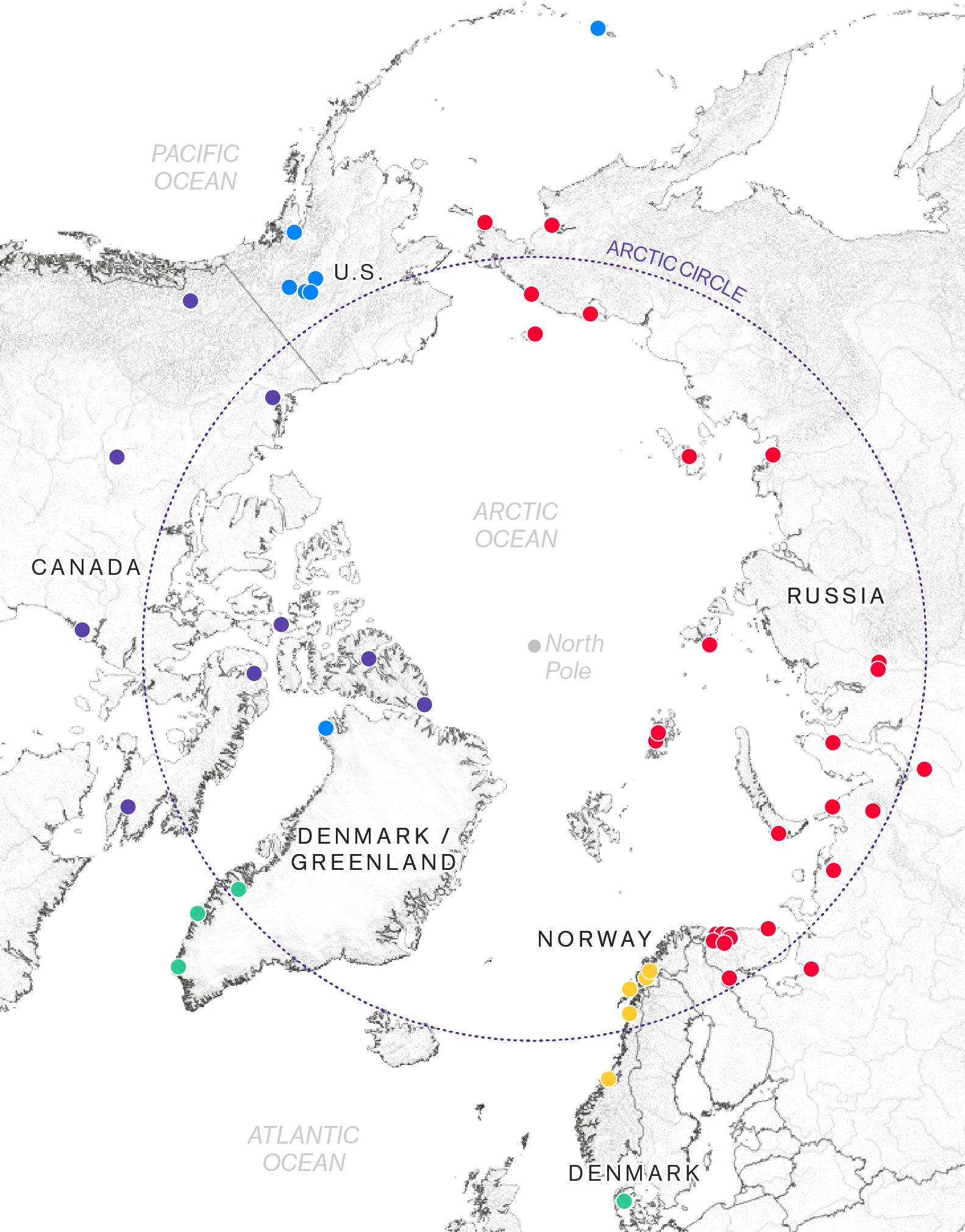
The complexity of the Arctic will grow as it attracts more economic attention—particularly, perhaps, as more dots are filled in on this map.
Arctic Military Facilities
Russia
Norway
Denmark/Greenland
Canada
U.S.

The rule of law is the foundation on which economies operate. It’s in no one’s economic interest to de-stabilize the high north. “Military and economic concerns are deeply intertwined in the Arctic,” wrote Stephanie Pezard and three RAND Corporation colleagues in March, “and … these concerns can, at times, lead to apparently disjointed Russian policies in the region.”
While the Cold War is long gone, Cold War rules still apply in the Arctic: Everything is fine. Just make no sudden movements—and hope there’s no accident or misunderstanding along the way.