


29th May, 2019
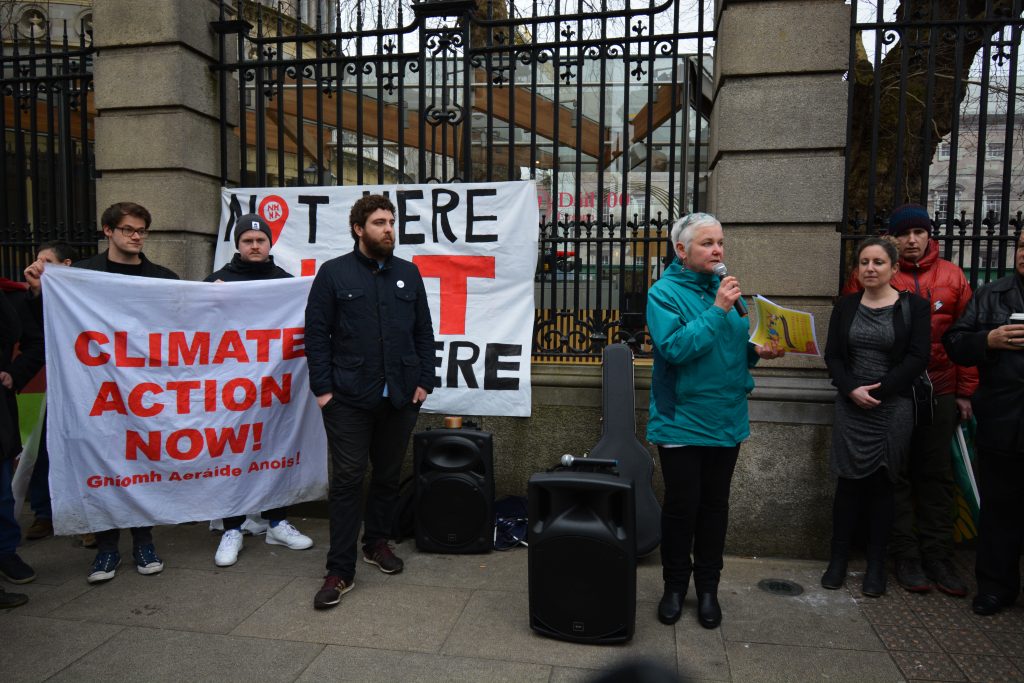
A Government decision that a “money message” is now required for a Bill to stop the issuing of fossil fuel licences is an attempt to “sabotage” its progress, People Before Profit (PBP) said today.
The Climate Emergency Measures Bill seeks to amend the
Petroleum and Other Minerals Development Act to limit the issuing of new
licenses for the exploration and extraction of fossil fuels.
Deputy Brid Smith’s Bill is slated to proceed to Committee Stage on 11 June. However, a letter sent yesterday to Ms Smith signed by the Minister for Natural Resources Sean Canney TD states that the Bill now requires a “money message”.
A money message is essentially a recommendation that is signed by the Taoiseach approving of legislation that is going to cost the State money as per Article 17.2 of the Constitution.
The Article states that no law that requires the spending of public money shall be passed without Government approval. Unless approval is received, a Bill cannot progress to Committee Stage.
The
money message
In a statement released today, PBP said that when the Bill was first approved by the Dail In February 2018, the Bills Office judged that it did not require a money message. The office found it would have no cost implications or need the appropriation of public funds, PBP said.
However, in the letter issues to Ms Smith yesterday, several estimated costs are outlined, including the repayment of application fees to licence applicants and acreage rental fees for existing licences, as well as legal fees for potential challenges by exploration companies.
PBP, however, have argued that the cost of inaction and the social cost of carbon need to be factored into any cost-benefit analysis of policy action on climate.
Speaking to The Green News, climate researcher Sadhbh O’Neill said that, while it is difficult to estimate the potential impact of not acting to limit new licenses, the implications of climate inaction need to be examined in climate proofing efforts.
“Any cost-benefit analysis that ignores the cost of inaction, or the social cost of greenhouse gases, has no place in any climate strategy,” added Ms O’Neill who served as an advisor to independent members of the Oireachtas Committee on Climate Action.
A 2018
paper from the Marine and Renewable Energy Ireland Centre (MAREI) at
University College Cork found that the social cost of carbon needs to be
included in the valuation of infrastructure investment planning.
MaREI researchers were also
involved in a paper released last month that found a delay in climate action
to 2030 has an “overall negative impact on the economy”.
“Early action combined with cost reductions in key renewable energy technologies can reduce GDP losses to minimal levels,” the paper states.
Blocking
the democratic process
UCD environmental policy fellow Dr Cara Augustenborg told The Green News that it is “shocking” to
see Fine Gael’s repeated use of money messages that is blocking the “democratic
process”.
“They have done this to the [Green Party’s] Waste Reduction Bill
and many other pieces of legislation that were voted for by majority of our
elected representatives.
“What gives [Fine Gael] the right to hold our country hostage because they think they know better than the majority of our elected representatives?” she said.
“These Bills should be allowed to proceed to debate and Fine Gael
should be brave enough to deal with their concerns by providing amendments
rather than hiding behind money messages.”
Green Party Councillor David Healy said that the money message is now
being used as the main instrument to prevent “the will of the Oireachtas from
being implemented”.
“It’s pretty much a closing down of what was a very positive development in the Oireachtas procedures of a new open process,” he said.
Sabotage
attempt
Speaking at an impromptu briefing this morning PBP deputy Richard Boyd Barrett said that the move is an attempt to “sabotage a Bill which will have a result of sabotaging the attempt to deal with climate change”.
“This should not prevent the will of the Dail or allow the people
being usurped yet again in a cynical procedural trick,” Deputy Richard noted. “It
is particularly outrageous following last week’s huge vote for climate action
at local and European level.”
In a statement, the Department of Climate Action (DCCAE) said that
fossil fuels will still be required to provide to meet electricity needs and provide
a back-up supply “when the wind isn’t blowing and the sun isn’t shining”.
“Halting exploration in the Irish Offshore as proposed in the
Climate Emergency Measures Bill would have no impact on our emissions and would
not help us meet our EU targets,” the Department said.
On Monday, the Department granted consent to CNOOC Petroleum Europe – a
subsidiary of the Chinese National Offshore Oil Company – for an exploratory
oil and gas well in the Porcupine Basin.
Oisin Coghlan of Friends of the Earth Ireland said, however, that by
the time any oil or gas discovered under newly granted licences would come on
stream “we have to be beyond the case of relying on oil and gas”.
“Looking for oil and gas now is about oil and gas you’d burn in
2035 or 2040. It’s not the gas you’d burn in 5 years’ time,” he added.
“This is not about turning off the gas in Corrib or stopping the
gas connector in Scotland, it’s about stopping looking for gas that we just
know we can’t afford to burn,” he continued.
Speaking at a pre-legislative
hearing on the Bill last year, Gregg Muttitt of the climate and energy
think tank Oil Change International said that the idea of using gas as a
transitional fuel is a “flawed” plan as it doesn’t fit within today’s market
budgets.
Mr Muttitt said that there is too much gas in the power system and that the transition to renewable power will be slower if gas is allowed to compete with wind and solar energy.
About the Author

The post Money message an attempt to “sabotage” climate Bill, says PBP appeared first on Green News Ireland.