

Abstract
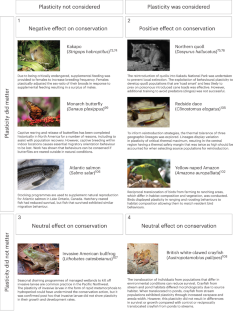
Phenotypic plasticity may help species to persist in the face of rapid change, yet we lack a management-friendly framework for incorporating plasticity into conservation practice. Here we emphasize the importance of phenotypic plasticity for management—when and how it matters—and describe three challenges that currently impede its consideration in conservation management. We propose a common language and framework that can be applied by scientists and conservation practitioners that connects plasticity to management actions. Crucially, our framework considers plasticity through the lens of an organism’s ‘fit’ to its environment and how that fit will be impacted by climatic changes. Finally, we present a road map for developing tools to highlight where consideration of plasticity is valuable for effective management.
This is a preview of subscription content, access via your institution
Access options
Access Nature and 54 other Nature Portfolio journals
Get Nature+, our best-value online-access subscription
$29.99 / 30 days
cancel any time
Subscribe to this journal
Receive 12 print issues and online access
$209.00 per year
only $17.42 per issue
Rent or buy this article
Prices vary by article type
from$1.95
to$39.95
Prices may be subject to local taxes which are calculated during checkout
References
-
Meehl, G. A. et al. Trends in extreme weather and climate events: issues related to modeling extremes in projections of future climate change. Bull. Am. Meteorol. Soc. 81, 427–436 (2000).
-
Hoegh-Guldberg, O., Jacob, D. & Taylor, M. in Special Report on Global Warming of 1.5 °C (eds Masson-Delmotte, V. et al.) 175–311 (IPCC, WMO, 2018).
-
Pörtner, H.-O. et al. (eds) Special Report on the Ocean and Cryosphere in a Changing Climate (IPCC, 2019).
-
Montoya, J. M. & Raffaelli, D. Climate change, biotic interactions and ecosystem services. Phil. Trans. R. Soc. B 365, 2013–2018 (2010).
-
Asseng, S. et al. Rising temperatures reduce global wheat production. Nat. Clim. Change 5, 143–147 (2015).
-
Arneth et al. Post-2020 biodiversity targets need to embrace climate change. Proc. Natl Acad. Sci. USA 117, 30882–30891 (2020).
-
Turner, M. G. et al. Climate change, ecosystems and abrupt change: science priorities. Phil. Trans. R. Soc. B 375, 20190105 (2020).
-
Radchuk, V. et al. Adaptive responses of animals to climate change are most likely insufficient. Nat. Commun. 10, 3109 (2019).
-
Charmantier, A. et al. Adaptive phenotypic plasticity in response to climate change in a wild bird population. Science 320, 800–803 (2008).
-
Visser, M. E. Keeping up with a warming world: assessing the rate of adaptation to climate change. Proc. R. Soc. B 275, 649–659 (2008).
-
Prober, S. M., Doerr, V. A. J., Broadhurst, L. M., Williams, K. J. & Dickson, F. Shifting the conservation paradigm: a synthesis of options for renovating nature under climate change. Ecol. Monogr. 89, e01333 (2019).
-
Beever, E. A. et al. Improving conservation outcomes with a new paradigm for understanding species’ fundamental and realized adaptive capacity. Conserv. Lett. 9, 131–137 (2016).
-
Pigliucci, M. Phenotypic Plasticity: Beyond Nature and Nurture. (Johns Hopkins Univ. Press, 2001.
-
West-Eberhard, M. J. Developmental Plasticity and Evolution (Oxford Univ. Press, 2003).
-
Thurman, L. L. et al. Persist in place or shift in space? Evaluating the adaptive capacity of species to climate change. Front. Ecol. Environ. 18, 520–528 (2020).
-
Donelson, J. M. et al. Understanding interactions between plasticity, adaptation and range shifts in response to marine environmental change. Phil. Trans. R. Soc. B 374, 20180186 (2019).
-
Angers, B., Castonguay, E. & Massicotte, R. Environmentally induced phenotypes and DNA methylation: how to deal with unpredictable conditions until the next generation and after. Mol. Ecol. 19, 1283–1295 (2010).
-
Duncan, E. J., Gluckman, P. D. & Dearden, P. K. Epigenetics, plasticity, and evolution: how do we link epigenetic change to phenotype? J. Exp. Zool. B 322, 208–220 (2014).
-
Seebacher, F., White, C. R. & Franklin, C. E. Physiological plasticity increases resilience of ectothermic animals to climate change. Nat. Clim. Change 5, 61–66 (2014).
-
Sandoval-Castillo, J. et al. Adaptation of plasticity to projected maximum temperatures and across climatically defined bioregions. Proc. Natl Acad. Sci. USA 117, 17112–17121 (2020).
-
Hendry, A. P. Key questions on the role of phenotypic plasticity in eco-evolutionary dynamics. J. Heredity 107, 25–41 (2016).
-
Gomez-Mestre, I. & Jovani, R. A heuristic model on the role of plasticity in adaptive evolution: plasticity increases adaptation, population viability and genetic variation. Proc. R. Soc. B 280, 20131869 (2013).
-
Schneider, R. F. & Meyer, A. How plasticity, genetic assimilation and cryptic genetic variation may contribute to adaptive radiations. Mol. Ecol. 26, 330–350 (2016).
-
Enbody, E. D. et al. Ecological adaptation in European eels is based on phenotypic plasticity. Proc. Natl Acad. Sci. USA 118, e2022620118 (2021).
-
Serrouya, R. et al. Saving endangered species using adaptive management. Proc. Natl Acad. Sci. USA 116, 6181–6186 (2019).
-
Gaitán-Espitia, J. D. & Hobday, A. J. Evolutionary principles and genetic considerations for guiding conservation interventions under climate change. Glob. Change Biol. 27, 475–488 (2021).
-
Valladares, F. et al. The effects of phenotypic plasticity and local adaptation on forecasts of species range shifts under climate change. Ecol. Lett. 17, 1351–1364 (2014).
-
Raimundo, R. L., Guimarães, P. R. Jr & Evans, D. M. Adaptive networks for restoration ecology. Trends Ecol. Evol. 33, 664–675 (2018).
-
Oostra, V., Saastamoinen, M., Zwaan, B. J. & Wheat, C. W. Strong phenotypic plasticity limits potential for evolutionary responses to climate change. Nat. Commun. 9, 1005 (2018).
-
Nicotra, A. B., Beever, E. A., Robertson, A. L., Hofmann, G. E. & O’Leary, J. Assessing the components of adaptive capacity to improve conservation and management efforts under global change. Conserv. Biol. 29, 1268–1278 (2015).
-
Thurman, L. L. et al. Applying assessments of adaptive capacity to inform natural-resource management in a changing climate. Conserv. Biol. 36, e13838 (2022).
-
Arnold, P. A., Nicotra, A. B. & Kruuk, L. E. B. Sparse evidence for selection on phenotypic plasticity in response to temperature. Phil. Trans. R. Soc. B 374, 20180185 (2019).
-
Acasuso-Rivero, C., Murren, C. J., Schlichting, C. D. & Steiner, U. K. Adaptive phenotypic plasticity for life-history and less fitness-related traits. Proc. R. Soc. B 286, 20190653 (2019).
-
Crates, R., Stojanovic, D. & Heinsohn, R. The phenotypic costs of captivity. Biol. Rev. https://doi.org/10.1111/brv.12913 (2022).
-
Jolly, C. J., Webb, J. K. & Phillips, B. L. The perils of paradise: an endangered species conserved on an island loses antipredator behaviours within 13 generations. Biol. Lett. 14, 20180222 (2018).
-
Muralidhar, A. et al. Know your enemy? Conservation management causes loss of antipredator behaviour to novel predators in New Zealand robins. Anim. Behav. 149, 135–142 (2019).
-
Johnson, C. N. et al. Biodiversity losses and conservation responses in the Anthropocene. Science 356, 270–275 (2017).
-
Cook, C. N. & Sgrò, C. M. Conservation practitioners’ understanding of how to manage evolutionary processes. Conserv. Biol. 33, 993–1001 (2019).
-
Paget, S., Gleiss, A., Kuchling, G. & Mitchell, N. J. Activity of a freshwater turtle varies across a latitudinal gradient: implications for the success of assisted colonisation. Funct. Ecol. https://doi.org/10.1111/1365-2435.14338 (2023).
-
Hendry, A. P. Eco-evolutionary Dynamics (Princeton Univ. Press, 2017).
-
Faulkner, K. T., Clusella-Trullas, S., Peck, L. S. & Chown, S. J. Lack of coherence in the warming responses of marine crustaceans. Funct. Ecol. 28, 895–903 (2014).
-
Ghalambor, C. K., McKay, J. K., Carroll, S. P. & Reznick, D. N. Adaptive versus non-adaptive phenotypic plasticity and the potential for contemporary adaptation in new environments. Funct. Ecol. 21, 394–407 (2007).
-
Marshall, D. J. & Arnold, T. When is a maternal effect adaptive? Oikos 116, 1957–1963 (2007).
-
Uller, T., Najagawa, S. & English, S. Weak evidence for anticipatory parental effects in plants and animals. J. Evol. Biol. 26, 2161–2170 (2013).
-
Scheiner, S. M. Genetics and evolution of phenotypic plasticity. Annu. Rev. Ecol. Syst. 24, 35–68 (1993).
-
Ghalambor, C. K., Martin, L. B. & Woods, H. A. in Integrative Organismal Biology 1st edn (eds Martin, L. B. et al.) Ch. 1 (John Wiley & Sons, 2015).
-
Davis, J. M. P., van Heerwaarden, B., Sgrò, C. M., Donald, J. A. & Kemp, D. J. Low genetic variation in cold tolerance linked to species distributions in butterflies. Evol. Ecol. 28, 495–504 (2013).
-
Herman, J. J., Spencer, H. G., Donohue, K. & Sultan, S. E. How stable ‘should’ epigenetic modifications be? Insights from adaptive plasticity and bet hedging. Evolution 68, 632–643 (2014).
-
Burgess, S. C. & Marshall, D. J. Adaptive parental effects: the importance of estimating environmental predictability and offspring fitness appropriately. Oikos 123, 769–776 (2014).
-
Leimar, O. & McNamara, J. M. The evolution of transgenerational integration of information in heterogeneous environments. Am. Nat. 185, E55–E69 (2015).
-
Reed, T. E., Waples, R. S., Schindler, D. E., Hard, J. J. & Kinnison, M. T. Phenotypic plasticity and population viability: the importance of environmental predictability. Proc. R. Soc. B 277, 3391–3400 (2010).
-
Leung, C., Rescan, M., Grulois, D. & Chevin, L. M. Reduced phenotypic plasticity evolves in less predictable environments. Ecol. Lett. 23, 1664–1672 (2020).
-
Schaum, C. E. & Collins, S. Plasticity predicts evolution in a marine alga. Proc. R. Soc. B 281, 20141486 (2014).
-
Nevoux, M., Forcada, J., Barbraud, C., Croxall, J. & Weimerskirch, H. Bet-hedging response to environmental variability, an intraspecific comparison. Ecology 91, 2416–2427 (2010).
-
Perkins-Kirkpatrick, S. E. & Lewis, S. C. Increasing trends in regional heatwaves. Nat. Commun. 11, 3357 (2020).
-
Chiang, F., Mazdiyasni, O. & AghaKouchak, A. Evidence of anthropogenic impacts on global drought frequency, duration and intensity. Nat. Commun. 12, 2754 (2021).
-
Cook, C. N. & Sgrò, C. M. Aligning science and policy to achieve evolutionary enlightened conservation. Conserv. Biol. 31, 501–512 (2016).
-
Villellas, J. et al. Phenotypic plasticity masks range-wide genetic differentiation for vegetative but not reproductive traits in a short-lived plant. Ecol. Lett. 24, 2378–2393 (2021).
-
Dai, P. et al. Life-history trait plasticity and its relationships with plant adaptation and insect fitness: a case study on the aphid Sitobion avenae. Sci. Rep. 6, 29974 (2016).
-
Bonnet, T. et al. The role of selection and evolution in changing parturition date in a red deer population. PLoS Biol. 17, e3000493 (2019).
-
Bell, D. L. & Galloway, L. F. Plasticity to neighbour shade: fitness consequences and allometry. Funct. Ecol. 21, 1146–1153 (2007).
-
Fisher, R. A. The Genetical Theory of Natural Selection (Clarendon, 1930).
-
Stearns, S. C. & Kawecki, T. J. Fitness sensitivity and the canalisation of life-history traits. Evolution 48, 1438–1450 (1994).
-
Crispo, E. The Baldwin effect and genetic assimilation: revisiting two mechanisms of evolutionary change mediated by phenotypic plasticity. Evolution 61, 2469–2479 (2007).
-
Barnosky, A. D. et al. Has the Earth’s sixth mass extinction already arrived? Nature 471, 51–57 (2011).
-
Ceballos, G., Ehrlich, P. R. & Raven, P. H. Vertebrates on the brink as indicators of biological annihilation and the sixth mass extinction. Proc. Natl Acad. Sci. USA 117, 13596–13602 (2020).
-
Cleves, P. A. et al. Reduced thermal tolerance in a coral carrying CRISPR-induced mutations in the gene for a heat-shock transcription factor. Proc. Natl Acad. Sci. USA 117, 28899–28905 (2020).
-
Chevin, L.-M., Gallet, R., Gomulkiewicz, R., Holt, R. D. & Fellous, S. Phenotypic plasticity in evolutionary rescue experiments. Proc. R. Soc. B 368, 20120089 (2013).
-
Bucharova, A. Assisted migration within species range ignores biotic interactions and lacks evidence. Restor. Ecol. 25, 14–18 (2017).
-
Stockwell, C. A., Hendry, A. P. & Kinnison, M. T. Contemporary evolution meets conservation biology. Trends Ecol. Evol. 18, 94–101 (2003).
-
Eger, A. M. et al. Playing to the positives: using synergies to enhance kelp forest restoration. Front. Mar. Sci. 7, 544 (2020).
-
Varner, J. & Dearing, M. D. Dietary plasticity in pikas as a strategy for atypical resource landscapes. J. Mammal. 95, 72–81 (2014).
-
Clout, M. N., Elliott, G. P. & Robertson, B. C. Effects of supplementary feeding on the offspring sex-ratio of kakapo: a dilemma for the conservation of a polygynous parrot. Biol. Conserv. 107, 13–18 (2002).
-
Robertson, B. C., Elliott, G. P., Eason, D. K., Clout, M. N. & Gemmell, N. J. Sex allocation theory aids species conservation. Biol. Lett. 2, 229–231 (2006).
-
Kelly, E. & Phillips, B. L. Targeted gene flow and rapid adaptation in an endangered marsupial. Conserv. Biol. 33, 112–121 (2019).
-
Jolly, C. J., Kelly, E., Gillespie, G. R., Phillips, B. & Webb, J. K. Out of the frying pan: reintroduction of toad-smart northern quolls to southern Kakadu National Park. Austr. Ecol. 43, 139–149 (2018).
-
Williams, S. E., Shoo, L. P., Isaac, J. L., Hoffmann, A. A. & Langham, G. Towards an integrated framework for assessing the vulnerability of species to climate change. PLoS Biol. 6, e325 (2008).
-
Stuart-Smith, R. D., Edgar, G. J. & Bates, A. E. Thermal limits to the geographic distributions of shallow-water marine species. Nat. Ecol. Evol. 1, 1846–1852 (2017).
-
van Heerwaarden, B. & Sgrò, C. M. Male fertility thermal limits predict vulnerability to climate warming. Nat. Commun. 12, 2214 (2021).
-
Gauzere, J. et al. Where is the optimum? Predicting the variation of selection along climatic gradients and the adaptive value of plasticity. A case study on tree phenology. Evol. Lett. 4, 109–123 (2020).
-
Schleuning, M. et al. Trait-based assessments of climate-change impacts on interacting species. Trends Ecol. Evol. 35, 319–328 (2020).
-
Hoffmann, A. A., Weeks, A. R. & Sgrò, C. M. Opportunities and challenges in assessing climate change vulnerability through genomics. Cell 184, 1420–1425 (2021).
-
Berkelmans, R. in Coral Bleaching Ecological Studies Vol. 205 (eds van Oppen, M. J. H. & Lough, J. M.) 103–119 (Springer, 2009).
-
Riddell, E. A., Odom, J. P., Damm, J. D. & Sears, M. W. Plasticity reveals hidden resistance to extinction under climate change in the global hotspot of salamander diversity. Sci. Adv. 4, eaar5471 (2018).
-
Natural England and the RSPB Climate Change Adaptation Manual—Evidence to Support Nature Conservation in a Changing Climate 2nd edn (Natural England, 2019).
-
Svensson, E. I., Gomez-Llano, M. & Waller, J. T. Selection on phenotypic plasticity favors thermal canalisation. Proc. Natl Acad. Sci. USA 117, 29767–29774 (2020).
-
Bailey, T. G. et al. Embedding genetics experiments in restoration to guide plant choice for a degraded landscape with a changing climate. Ecol. Manag. Restor. 22, 92–105 (2021).
-
Hoffmann, E. P., Cavanough, K. L. & Mitchell, N. J. Low desiccation and thermal tolerance constrains a terrestrial amphibian to a rare and disappearing microclimate niche. Conserv. Physiol. 9, coab027 (2021).
-
Blackburn, T. M. & Duncan, R. P. Determinants of establishment success in introduced birds. Nature 414, 195–197 (2001).
-
Buckley, L. B., Schoville, S. D. & Williams, C. M. Shifts in the relative fitness contributions of fecundity and survival in variable and changing environments. J. Exp. Biol. 224, jeb228031 (2021).
-
Takahashi, Y. et al. Evolution of increased phenotypic diversity enhances population performance by reducing sexual harassment in damselflies. Nat. Commun. 5, 4468 (2014).
-
Preece, C., Verbruggen, E., Liu, L., Weedon, J. & Penuelas, J. Effects of past and current drought on the composition and diversity of soil microbial communities. Soil Biol. Biochem. 131, 28–39 (2019).
-
Ducatez, S., Sol, D., Sayol, F. & Lefebre, L. Behavioral plasticity is associated with reduced extinction risk in birds. Nat. Ecol. Evol. 4, 788–793 (2020).
-
Kuchling, G. & Hofmeyr, M. D. Too hot to nest? In a hot summer the tortoise Chersina angulata can switch from nesting to facultative viviparity. Front. Ecol. Evol. 9, 788764 (2022).
-
Richards, C. L., Bossdorf, O., Muth, N. Z., Gurevitch, J. & Pigliucci, M. Jack of all trades, master of some? On the role of phenotypic plasticity in plant invasions. Ecol. Lett. 9, 981–993 (2006).
-
Davidson, A. M., Jennions, M. D. & Nicotra, A. B. Do invasive species show higher phenotypic plasticity than native species and, if so, is it adaptive? A meta‐analysis. Ecol. Lett. 14, 419–431 (2011).
-
Singer, M. C. & Parmesan, C. Lethal trap created by adaptive evolutionary response to an exotic resource. Nature 557, 238–241 (2018).
-
Jørgensen, C., Ernande, B. & Fiksen, Ø. Size-selective fishing gear and life history evolution in the Northeast Arctic cod. Evol. Appl. 2, 356–370 (2009).
-
Tenger-Trolander, A., Lu, W., Noyes, M. & Kronforst, M. R. Contemporary loss of migration in monarch butterflies. Proc. Natl Acad. Sci. USA 116, 14671–14676 (2019).
-
Mitchell, N. J., Rodriguez, N., Kuchling, G., Arnall, S. G. & Kearney, M. R. Reptile embryos and climate change: modelling limits of viability to inform translocation decisions. Biol. Conserv. 204, 134–147 (2016).
-
Sargent, R., Deere, N. J., McGowan, P. J. K., Bunnefeld, N. & Pfeifer, M. Room to roam for African lions Panthera leo: a review of the key drivers of lion habitat use and implications for conservation. Mammal. Rev. 52, 39–51 (2021).
-
Salinas-Melgoza, A., Salinas-Melgoza, V. & Wright, T. F. Behavioral plasticity of a threatened parrot in human-modified landscapes. Biol. Conserv. 159, 303–312 (2013).
-
Watters, J. V., Lema, S. C. & Nevitt, G. A. Phenotype management: a new approach to habitat restoration. Biol. Conserv. 112, 435–445 (2003).
-
Wang, J. et al. Effects of heterogeneous environment after deforestation on plant phenotypic plasticity of three shrubs based on leaf traits and biomass allocation. Front. Ecol. Evol. 9, 608663 (2021).
-
Turko, A. J. et al. Choosing source populations for conservation reintroductions: lessons from variation in thermal tolerance among populations of the imperilled redside dace. Can. J. Fish. Aquat. Sci. 78, 1347–1355 (2021).
-
Larocque, S. M., Johnson, T. B. & Fisk, A. T. Survival and migration patterns of naturally and hatchery-reared Atlantic salmon (Salmo salar) smolts in a Lake Ontario tributary using acoustic telemetry. Freshw. Biol. 65, 835–848 (2020).
-
Cook, M. T., Heppell, S. S. & Garcia, T. S. Invasive bullfrog larvae lack developmental plasticity to changing hydroperiod. J. Wildl. Manag. 77, 655–662 (2013).
-
Haddaway, N. R., Mortimer, R. J. G., Christmas, M., Grahame, J. W. & Dunn, A. M. Morphological diversity and phenotypic plasticity in the threatened British white-clawed crayfish (Austropotamobius pallipes). Aquat. Conserv. 22, 220–231 (2012).
-
Angeler, D. G. et al. in Advances in Ecological Research Vol. 60 (eds Bohan, D. A. & Dumbrell, A. J.) 1–24 (Academic, 2019).
-
Hoffmann, A. A., Sgrò, C. M. & Kristensen, T. N. Revisiting adaptive potential, population size, and conservation. Trends Ecol. Evol. 32, 506–517 (2017).
-
Duncan, D. H. & Wintle, B. A. in Landscape Analysis and Visualisation (eds Pettit, C. et al.) 159–182 (Springer, 2008).
-
Kokko, H. The stagnation paradox: the ever-improving but (more or less) stationary population fitness. Proc. R. Soc. B 288, 20212145 (2021).
-
IPCC Climate Change 2007: Impacts, Adaptation and Vulnerability (eds Parry, M. L. et al.) 6 (Cambridge Univ. Press, 2007).
-
Steeves, T. E., Johnson, J. A. & Hale, M. L. Maximising evolutionary potential in functional proxies for extinct species: a conservation genetic perspective on de-extinction. Funct. Ecol. 31, 1032–1040 (2017).
-
Thompson, J. D. Phenotypic plasticity as a component of evolutionary change. Trends Ecol. Evol. 6, 246–249 (1991).
-
Seddon, P. J., Griffiths, C. J., Soorae, P. S. & Armstrong, D. P. Reversing defaunation: restoring species in a changing world. Science 345, 406–412 (2014).
-
Translocation of Living Organisms: IUCN Position Statement (IUCN, 1987).
-
IUCN/SSC Guidelines for Reintroductions and Other Conservation Translocations Version 1.0. (IUCN Species Survival Commission, 2013).
-
Weeks, A. R. et al. Assessing the benefits and risks of translocations in changing environments: a genetic perspective. Evol. Appl. 4, 709–725 (2011).
Acknowledgements
This paper is based on discussions at the 2020 Ecological Adaptation and Plasticity into Practice (EcolAPP) Workshop. We thank our colleagues C. Sgrò, A. Nicotra and R. Incoll for their participation in the workshop and additional helpful contributions. We thank S. Prasad and M. Lee-Abbott of ThinkPlace, Canberra, for their help transforming the workshop into a successful online event in the wake of COVID-19 lockdowns. The EcolAPP Workshop was funded by a Synthesis Group Grant from the Centre for Biodiversity Analysis (CBA) at The Australian National University (to R.J.F.). We also thank C. Stephens of the CBA for administrative support and encouragement of EMCR initiatives. J.M.D. was supported by an ARC Future Fellowship (FT190100015). We thank S. McMahon for helpful feedback on Figs. 1 and 2.
Author information
Ethics declarations
Competing interests
The authors declare no competing interests.
Additional information
Publisher’s note Springer Nature remains neutral with regard to jurisdictional claims in published maps and institutional affiliations.
Rights and permissions
Springer Nature or its licensor (e.g. a society or other partner) holds exclusive rights to this article under a publishing agreement with the author(s) or other rightsholder(s); author self-archiving of the accepted manuscript version of this article is solely governed by the terms of such publishing agreement and applicable law.
About this article
Cite this article
Donelson, J.M., Gaitan-Espitia, J.D., Hobday, A.J. et al. Putting plasticity into practice for effective conservation actions under climate change.
Nat. Clim. Chang. (2023). https://doi.org/10.1038/s41558-023-01706-4
-
Received: 01 March 2022
-
Accepted: 18 May 2023
-
Published: 06 July 2023
-
DOI: https://doi.org/10.1038/s41558-023-01706-4