


With the country poised for Sunday’s elections, the murder of environmentalists in Honduras is being directly linked with water and food shortages, violence and migration. Photographer Sean Hawkey visited what has become a frontline of climate change conflict
-
The day after the assassination of José de los Santos Sevilla, the Tolupán people bury their leader in the forest of Montaña de la Flor. Killed at home on the morning of 17 February 2017, he is one of several Tolupán leaders to be assassinated in the past decade. The murders are believed to be linked to land rights and tenure, as mining and logging companies make efforts to take natural resources and land from the Tolupán
<!–[if IE 9]><![endif]–>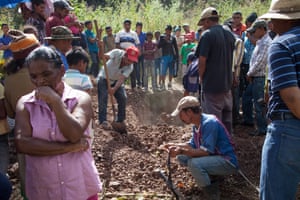
-
Assassinations of indigenous and environmentalist leaders and journalists in Honduras have risen sharply since President Manuel Zelaya was ousted in 2009. Human rights group Global Witness has published a list of
123 verified killings. Locals believe the true figure is much higher<!–[if IE 9]><![endif]–>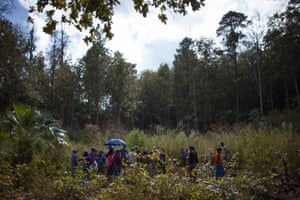
-
Santos Sevilla was killed at his home in Montaña de la Flor, where he lived with his wife and six children. He was shot three times; the third bullet was fired at his head from point blank range
<!–[if IE 9]><![endif]–>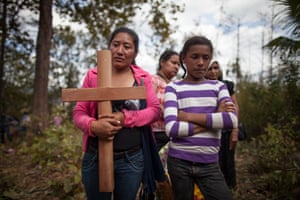
-
In March this year, a protest was held to commemorate the
assassination of Lenca leader and environmentalist Berta Cáceres in 2016. While the people who shot Cáceres have been arrested, those who ordered her killing – as well as the murder of many other indigenous and environmentalist leaders in Honduras – have not been charged. Cáceres is an emblematic figure in Honduras, but there are well over a hundred similar cases in the country<!–[if IE 9]><![endif]–>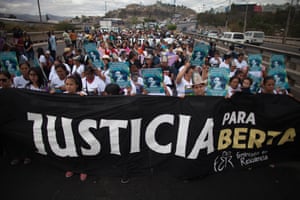
-
-
Water and food shortages have been linked to the murder of environmentalists. Drought in the region of southern Honduras is entering its ninth year; José Santos García, a local well-digger, has never been busier. He is deepening a 15-metre borehole that has dried up in an attempt to find water for people nearby. The prolonged drought is believed to be linked to poor watershed management, over-exploitation of natural resources, and climate change
<!–[if IE 9]><![endif]–>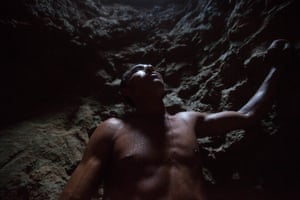
-
The unrelenting drought has caused crops to perish and left people struggling to survive in southern Honduras. This landscape near Nacaome is scorched by spontaneous fires. Crops in the area have failed repeatedly, and farmers lose seed in futile attempts to grow food. With the crisis deepening, many people are leaving the area
<!–[if IE 9]><![endif]–>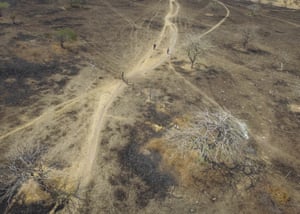
-
Yanina Avila, 18, is the daugher of José de los Santos Sevilla. Walking along a river in Montaña de la Flor, Avila talks of her father’s fear of encroaching mining and logging companies, and how defenceless the Tolupán people are against them. ‘My father died protecting this forest,’ she says. ‘They will carry on killing us – people who look after nature – maybe until we’re all gone’
<!–[if IE 9]><![endif]–>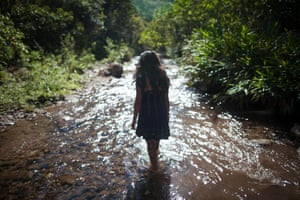
-
Oscar Alexis Maldonado Ramírez rides his horse Palomo along a dry stretch of the Río Nacaome. ‘We’re in the middle of what was the river. It shouldn’t be like this, should it? Even when it rains, which is rare now, the water disappears quickly. The crops fail without irrigation, but now the wells keep drying up so we can’t irrigate. I’ve taken my cattle away – they can’t survive here without water. In fact, we can’t survive here without water’
<!–[if IE 9]><![endif]–>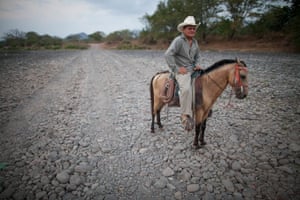
-
-
Israel Martínez in Montaña de la Flor, two days after the assassination of his friend and fellow Tolupán José de los Santos Sevilla. ‘See the frogspawn? It’s everywhere,’ he says. ‘See the snails in the water? The animals drink this water, we drink this water straight from the river. The water in [the Ladino people’s] places is poisoned with fertilisers and by the ones who do the mining. They don’t have frogs and snails any more – they’re already dead. And now [others] want our land, our trees, they want to ruin our water, dry up our rivers. And they want to kill us. They are killing us’
<!–[if IE 9]><![endif]–>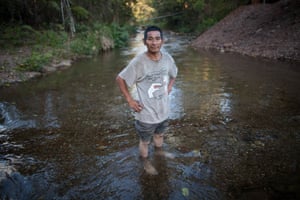
-
The Gualcarque river at Río Blanco, Intibucá. Lenca men retrieve part of a bridge that they have rebuilt several times after it was destroyed by police. The river is sacred to the Lenca, who continue to protest against
a proposed hydroelectric dam at this point in the river – the dam opposed by
Berta Cáceres. The Lenca’s demonstrations have been met with violence, and several people have been beaten and killed<!–[if IE 9]><![endif]–>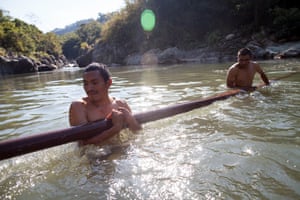
-
Access to water in the major cities is becoming a vital concern as reservoirs dry up. In the Rivera Hernández neighbourhood on the outskirts of San Pedro Sula, northern Honduras, José Maradiaga digs a well in search of water after four weeks without supply
<!–[if IE 9]><![endif]–>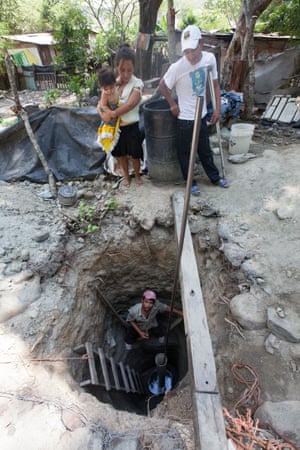
-
The dry riverbed of the Río Chiquito, in Nacaome
<!–[if IE 9]><![endif]–>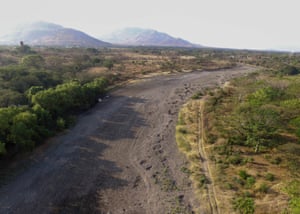
-
-
At a rubbish dump on the outskirts of San Pedro Sula, people who pick through rubbish have found the body of woman who was kidnapped and tortured to death. Many people come to the marginal areas of the already stressed and violent cities escaping impossible conditions in the countryside, where there is no water and little to eat. Food insecurity brings increasing violence, as more people turn to crime in desperation. Extreme levels of violence in Honduras are pushing people out of the country. Many attempt the hazardous journey to the US
<!–[if IE 9]><![endif]–>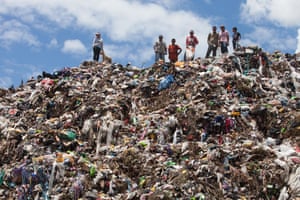
-
Garifuna people, seen here playing drums and maracas, joined the Maya Chortís, Pech, Tolupán, Miskito and Lenca peoples, in a march for the anniversary of the assassination of environmentalist Berta Cáceres in the Honduran capital, Tegucigalpa. With no substantial political changes in the country, there is no end in sight to the wave of killings of environmentalists, indigenous leaders and journalists
<!–[if IE 9]><![endif]–>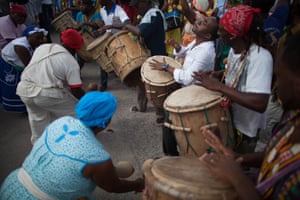
-
Riot police in front of the National University of Honduras use teargas on students protesting over the lack of justice for Berta Cáceres on the anniversary of her assassination. University students frequently block major roads in Tegucigalpa, and are met with strong-arm tactics, intimidation and violence
<!–[if IE 9]><![endif]–>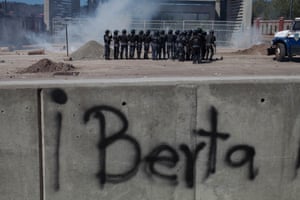
-
Laura Zuñiga Cáceres, daughter of the murdered activist, warns against taking on a role of ‘repressed and depressed victims’. ‘It will strengthen the terror and fear that the assassinations bring. Of course it affects us sometimes, but we are conscious of what we want to achieve, and we want to break this role. We want to revindicate life. We want to revindicate the work of my mum and everything that her lifelong and collective struggles meant. We are strong and we have justice in our hands. We will continue working like she worked. We are continuing her struggle’
<!–[if IE 9]><![endif]–>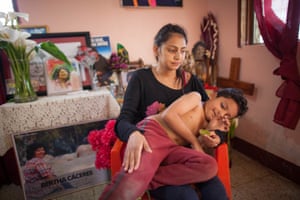
-