




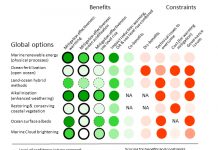
Guest post: 13 ‘ocean-based solutions’ for tackling climate change
Dr Phillip Williamson is an honorary reader at the University of East Anglia and science coordinator of the UK Greenhouse Gas Removal from the...

Analyse : Quel « budget carbone » pour limiter le réchauffement climatique à 1,5C...
En signant l’accord de Paris sur le changement climatique en 2015, presque tous les pays du monde se sont engagés à maintenir l’élévation de...

Q&A: How ‘integrated assessment models’ are used to study climate change
Working out the best ways to tackle climate change is one of the key challenges facing policymakers both today and in the decades ahead.
To...
World must act quickly to govern solar geoengineering, report says
Actions to manage solar geoengineering must “begin now”, says a report by an international group of governance experts.
The idea of solar geoengineering – a set...
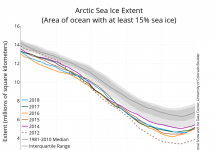
Arctic sea ice summer minimum in 2018 is sixth lowest on record
Arctic sea ice has reached its summer minimum extent for the year, clocking in at 4.59m square kilometres (sq km), which puts it joint...
Record 2017 hurricane season driven by warm Atlantic Ocean, study says
Last year’s record hurricane season – which saw Hurricane Harvey, Irma and Maria cause devastation across North and Central America – was primarily driven by “pronounced...
Mapped: How every part of the world has warmed – and could continue to...
Climate change is often communicated by looking at the global average temperature. But a global average might not mean much to the average person....
Guest post: Credible tracking of land-use emissions under the Paris Agreement
Dr Giacomo Grassi is a scientific officer at the Joint Research Centre of the European Commission; Dr Jo House is a reader in environmental...
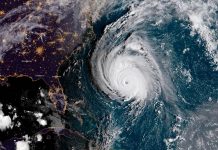
Guest post: How Arctic warming could have steered Hurricane Florence towards the US
Prof Jennifer Francis is a research professor in the Department of Marine and Coastal Sciences at Rutgers University in New Jersey, US.
At around 7:15am...
Limiting warming to 2C would prevent ‘worldwide increases’ in heat-related deaths
Restricting global warming to 2C above pre-industrial levels would prevent large increases in temperature-related deaths across much of the globe, a new study finds.
And...
Latest news


Popular Articles

Gorillas, rhinos, lions and more will soon become extinct without immediate action
A report by 43 wildlife experts warns that without changes now, many of Earth's most iconic species will be lost forever.
Link to full source:...

Do you see a devil in this orchid?
Named for 'el diablo' himself, a new and extremely rare orchid species reveals a wicked heart.
Link to full source: Do you see a devil...

Florida man arrested for stealing sea turtle eggs
He's given a whole new meaning to "poached eggs."
Link to full source: Florida man arrested for stealing sea turtle eggs

Rare blindcat found in US, could prove water-filled caves connect Texas and Mexico
The extremely rare cave-dwelling albino fish with no eyes, the Mexican blindcat, has previously only been known to exist in Mexico.
Link to full source:...

10 magical places saved by endangered species
In our efforts to save animals at risk of extinction, we've saved some extraordinary places as well.
Link to full source: 10 magical places saved...